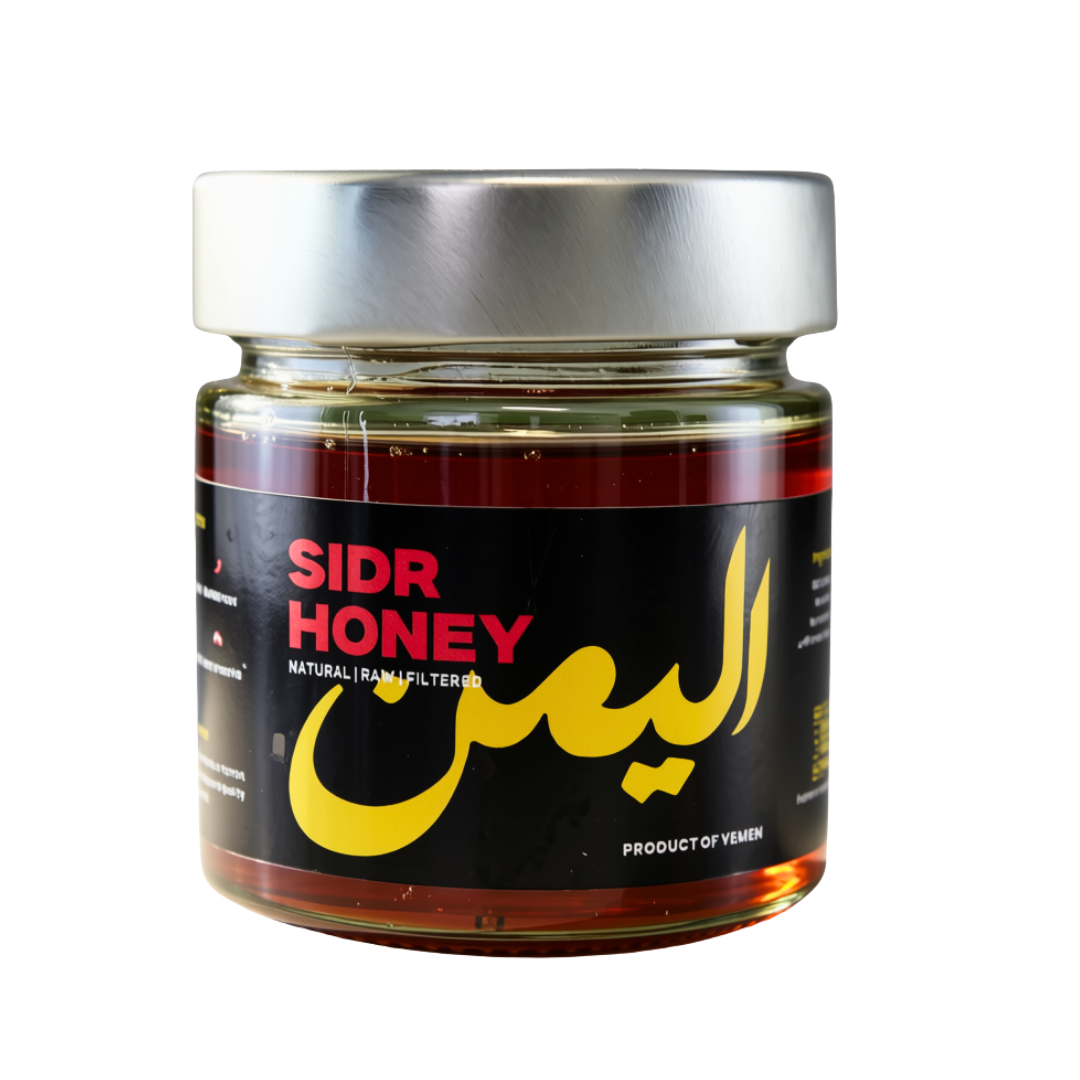
Yemeni sidr honey trades internationally at roughly R2 500 to R8 250 a kilogram. Ordinary raw honey on a South African shelf costs R85 to R155 for 500g. A gap that wide attracts fraud, and honey’s already one of the most faked foods on earth.
Three numbers and one import rule cover most of the protection you need. We sell a sidr honey ourselves. Every check below applies to us too.
Sidr honey comes from the nectar of Ziziphus spina-christi, a thorny, drought-hardy tree that grows wild across the Arabian Peninsula and the Horn of Africa. The tree carries real weight in Muslim households: it’s named in the Quran as Sidrat al-Muntaha, the lote tree of the furthest boundary. The honey itself is never mentioned there, whatever some product pages imply. The most prized jars come from Wadi Do’an in Yemen’s Hadhramaut region, where hives travel in on trucks and pack animals for a bloom that lasts a few weeks, mainly once a year.
Almost none of it reaches South Africa through visible channels. Takealot carries a Yemeni sidr listing, the odd specialist shop stocks a jar or two, and that’s roughly the whole visible market. We couldn’t find a single established local retailer selling verified Yemeni sidr at anything close to international prices. The serious jars mostly arrive through overseas webshops or in hand luggage, one at a time, with an uncle flying home via Doha. Which leaves a South African buyer in an awkward spot: paying import-grade money to whoever happens to have stock, with very little to compare against.
This is the part no sidr article seems to cover, and it’s specific to South Africa. Importing honey requires a permit under the Agricultural Pests Act of 1983, and a condition of that permit is that the honey gets irradiated, to stop the spread of American foulbrood, a bacterial disease that wipes out honeybee colonies. It applies to every jar of foreign honey that enters the country lawfully. Sidr is no exception.
The label has to say so. Under regulation R835 of 2000, irradiated honey must carry the word “irradiated” or “radurised” in letters at least 3 mm high near the product name, along with a country of origin. So the label on an imported jar is a small honesty test you can run before you’ve tasted anything.
Now the raw question, because it trips everyone up. In South African law, raw honey means unfiltered honey that’s never been heated above 38 degrees Celsius. Irradiation isn’t heating. It’s a cold process aimed at a bee disease rather than at the honey, so an imported jar can be legally raw and irradiated at the same time, and the label should carry both words. But if someone sells you imported honey as completely untreated, one of two things is true: they’re loose with words, or the jar didn’t come through the permit system. Neither should relax you. And if a non-irradiated jar is specifically what you’re after, that means local honey by definition; no legal import qualifies.
Sidr pricing only makes sense as tiers, because the same tree species grows in several countries and the valley matters more than the species. Rough bands, converted to rand at about R16.50 to the dollar and rounded, checked in August 2026:
Those Yemeni numbers hold up at retail. The Raw Honey Shop in the UK sells 220g of Wadi Do’an sidr for £63.75 to £75, around R6 400 to R7 500 a kilogram. Lote & Co charges £160 for 500g of its winter harvest, about R7 000 a kilogram. And trade sources say genuine Yemeni sidr can’t be bought at origin below roughly R2 000 to R2 500 a kilogram, partly because Gulf buyers, who take an estimated 60 to 70% of Yemen’s exports as wedding and gift stock, will pay it.
That origin floor turns price into a filter. A Johannesburg Islamic lifestyle store lists a 250g sidr honey at R180, which works out to R720 a kilogram, squarely in line with Pakistani beri pricing. Nothing wrong with Pakistani sidr at a Pakistani price; it’s honey from the same species of tree. But R720 a kilogram cannot be Yemeni, because no importer sells stock for a third of what it cost to buy. When the label says Yemen and the price says otherwise, believe the price. For scale: ordinary South African raw honey sells for R85 to R110 per 500g in supermarkets, and our own everyday raw honey is R155 for 500g, which comes to R310 a kilogram. Yemeni sidr starts at about eight times that, and the famous valleys run past twenty-five. The gap is the story, not a mistake.
Honey sits third on Michigan State University’s ranking of the most faked foods. An EU enforcement sweep flagged 46% of 320 imported honey samples as suspect, and a Canadian crackdown found 22% of 244 samples adulterated. The dearer the honey, the harder it gets hit. Peer-reviewed work describes sidr as one of the most adulterated honeys in the world, for the obvious reason.
It happens three ways. Syrup gets blended into real honey after harvest. Bees get fed sugar syrup during the nectar flow, which produces a jar that looks, pours and crystallises like the real thing. Or the origin is simply swapped: Pakistani, Kashmiri or Indian sidr, or a different honey entirely, relabelled as Yemeni. That last one isn’t hypothetical. A UK retailer lab-tested a supposed Yemeni sidr sample and found it was Spanish chestnut honey.
Home tests won’t rescue you. The water test, the flame test and the rest of the kitchen folklore can’t detect skilled adulteration. What works is lab work, pollen analysis showing dominant Ziziphus pollen and sugar screening by NMR, and it’s priced accordingly: an NMR spectrometer starts at about R2.5 million, per-sample runs are expensive, and a result only means something against a database of authenticated reference samples, which barely exists for a niche origin like Yemeni sidr. That’s why “lab tested” is rare in honey retail, and why a seller such as Balqees, which publishes a downloadable lab report, is the exception rather than the norm. So the working method for a buyer isn’t chemistry. It’s price arithmetic, provenance detail and the questions below.
Put these to any seller, us included. You’re listening for specifics, and for comfort with the word “no”.
It’s the same buying philosophy as our guide to where to buy shilajit in South Africa: when the origin story is vague and the price looks like a favour, it isn’t one.
Our Pure Raw Yemeni Sidr Honey is a 250g jar at R3 000. That’s R12 a gram, at the expensive end of the market described above, and we’d sooner you knew that going in. The jar is sourced from Yemen, from sidr nectar, raw and unheated, traditionally harvested; in the mouth it’s a thick honey with a buttery sweetness that ends on caramel. If what you want is honey for tea and porridge, don’t buy it. Our everyday raw honey is R155 for 500g and does that job. Sidr is for eating slowly off a spoon, and for the kind of gift that has to mean something. And before you pay us, ask us the four questions above. We’d rather answer them than be waved through.
Very few places sell it. Takealot has a listing, some specialist shops stock jars at Pakistani-tier prices, and the top Yemeni grades mostly come via overseas webshops. We sell a 250g Yemeni jar for R3 000 through our own store.
Same tree, different economics. Yemeni sidr comes from wild trees in a handful of remote valleys, harvested over a few weeks a year, and Gulf buyers absorb an estimated 60 to 70% of exports. Pakistani and Kashmiri sidr are plentiful by comparison, at R120 to R660 a kilogram.
Not meaningfully. Kitchen tests like the water or flame trick can’t detect skilled adulteration, and even labs need pollen analysis and NMR screening to do it properly. Your usable checks are the price arithmetic and the seller’s answers to direct questions.
It can be. Raw has a legal meaning here, unfiltered and never heated above 38 degrees Celsius, while irradiation is a separate cold requirement for all legal honey imports. A jar can be both, and the label must carry the word “irradiated” either way.
Eventually, yes. Sidr’s low moisture slows granulation, which is where the “never crystallises” sales line comes from, but slow isn’t never. South African regulations class crystallisation as a natural process, and it says nothing about quality either way.
Divide the price by the weight before anything else. If a “Yemeni sidr” comes out under about R2 000 a kilogram, you’ve got your answer without opening the jar. Then read the label for a country of origin and the irradiation wording, and put the four questions to the seller. If the answers go vague, keep your money. The whole exercise takes five minutes and costs nothing, which makes it the best value in this entire market.
Honey of any kind, sidr included, is not suitable for babies under one year of age.
We publish the full laboratory report for the batch shipping now, with the method named beside every result. Read it in full.
See the certificate