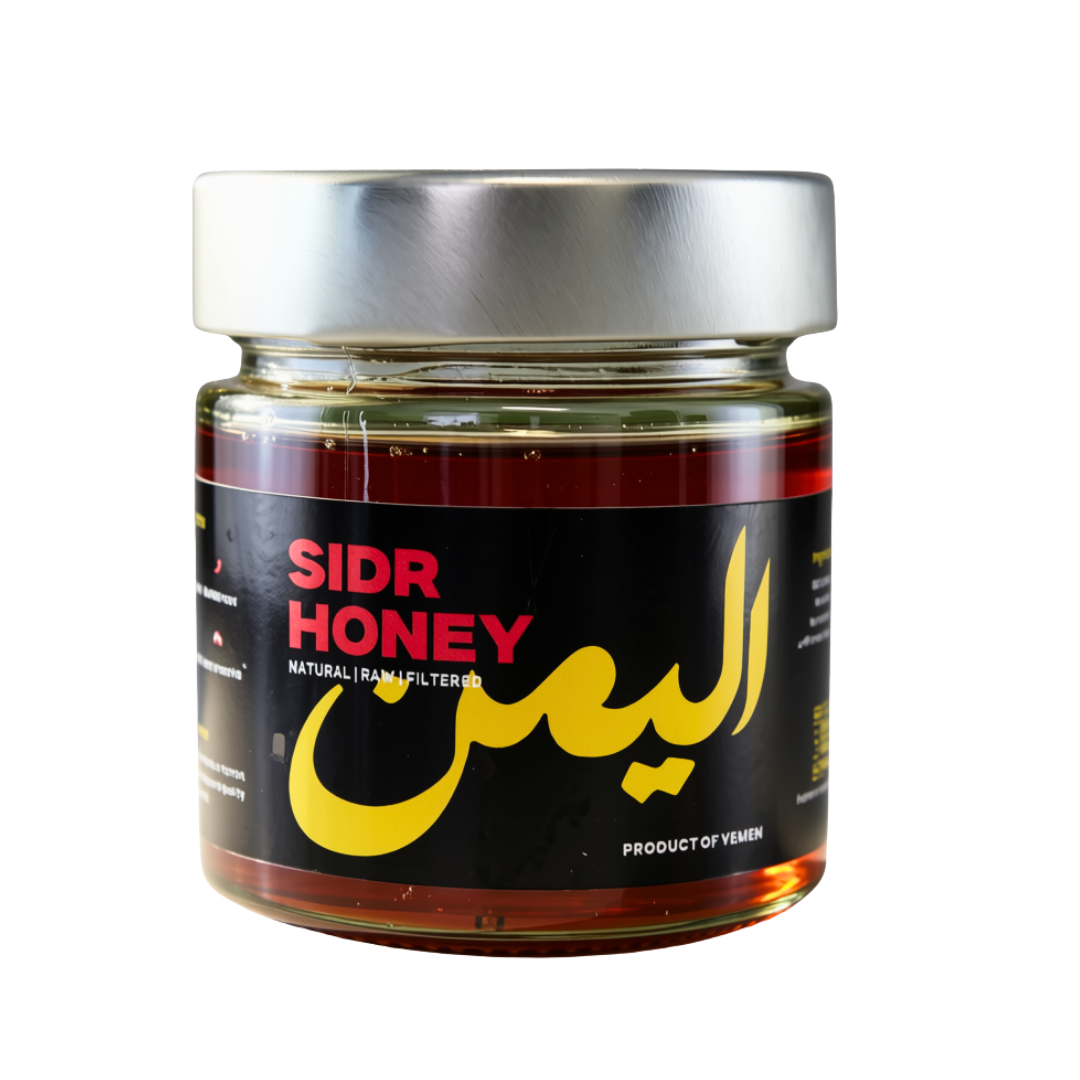
A jar of manuka honey has a number on the front: MGO 263+, UMF 10+, a figure a licensed lab measured and signed off. A jar of sidr honey has the name of a Yemeni valley and a season, and nothing else. That gap, a certificate against a story, is the whole sidr honey vs manuka question, and it decides which jar belongs in your kitchen.
We sell the sidr, a 250g jar at R3 000, and manuka still takes some of the rounds below.
Sidr honey comes from the nectar of the sidr tree, Ziziphus spina-christi, a thorny evergreen with a taproot deep enough to live on almost no rain. It grows wild across the Arabian Peninsula and the Horn of Africa, but the honey buyers chase hardest comes from Yemen: the valleys of Hadhramaut, the highlands around Usaymat, the Shabwa plateau. One valley, Wadi Do’an in Hadhramaut, fetches the highest prices of all, and its entire annual output is estimated at just 5 to 7 tonnes.
The bees are small, heat-adapted natives, Apis mellifera jemenitica, kept largely in traditional hives. Beekeepers follow the bloom the way shepherds follow grazing, moving hives by truck and pack animal into the wadis when the trees flower, then harvesting by hand. The bloom is short. The honey is taken mainly once a year, in a window of a few weeks, and because little else flowers in those desert valleys at the same time, sidr honey can come almost entirely from that one tree’s nectar. The tree also carries weight far beyond food: it’s named in the Quran, which is part of why the honey is a serious gift across the Gulf and in Muslim communities here. The tree, note, not the honey; the honey itself isn’t named in the Quran, whatever some sellers imply.
Manuka is the opposite story: a modern, organised industry built on the manuka bush of New Zealand, with licensed producers, export rules and a grading standard that took decades to build. Where sidr’s supply chain is a man with a knife in a remote wadi, manuka’s is a laboratory with a logo.
The number on a manuka label means something specific. An MGO rating states the measured concentration of methylglyoxal in milligrams per kilogram, so MGO 263+ is a lab result, not a slogan. The UMF system goes further and tests four markers: methylglyoxal, the same compound the MGO number reports, leptosperin (found only in manuka nectar) to confirm the jar is manuka at all, DHA to predict how the methylglyoxal level holds over shelf life, and HMF to catch heat damage. It’s a licensed New Zealand standard with an association behind it.
Sidr has no equivalent. None. There’s no grading body, no licence and no number, and the labels that look like grades, “Royal”, “Grade AA+”, “Class A”, are marketing terms a seller can print at will. What careful buyers rely on instead is provenance: a named valley rather than a vague “product of Yemen”, a stated harvest season, and a supplier they’d trust with R3 000. That vacuum has consequences. Researchers describe sidr as one of the most adulterated honeys in the world, precisely because of its price, and when a UK raw honey shop lab-tested a supposed Yemeni sidr, it turned out to be Spanish chestnut honey.
Score this round for manuka, and it isn’t close.
The measurable difference between these two jars is the size of the research file behind each one, and that file explains how each gets marketed. Manuka’s file runs to decades of published work, which is exactly what a graded, standardised export product makes possible: a lab can’t study a product it can’t define. Sidr’s file is thin and recent. There’s a 2009 study in Otolaryngology-Head and Neck Surgery that examined Yemeni sidr and New Zealand manuka side by side in laboratory conditions, a 2025 in vitro study on Yemeni sidr and a 2026 review in Food Bioscience, and that’s roughly the whole pile. Retail blogs love quoting exact percentages from the 2009 paper, usually with sidr edging manuka, but the figures mutate from blog to blog, and a laboratory dish isn’t a person.
If a research file is what you want behind your honey, buy manuka. Nobody selling sidr can tell you otherwise with a straight face.
Put a spoon of each side by side and you don’t need a lab. Sidr is thick and low in moisture, deep gold to dark amber in colour, darkening and reddening as it ages. Ours pours slowly, like cold syrup, and tastes of caramel and butterscotch with a malty finish that hangs around. Manuka is a different animal: earthier and herbaceous, with a slight bitterness, and it’s often sold creamed rather than clear.
Which tastes better is opinion, so here’s ours. Manuka gets sold like a supplement; sidr is unmistakably food. On a spoon, over yoghurt or stirred into warm milk, sidr wins for us and it isn’t a difficult call. But if you like dark, slightly bitter flavours, the fynbos end of the spectrum, you may well side with manuka.
Ordinary raw honey is grocery money: ours is R155 for 500g, or R320 for the 1.5kg jar. Mainstream manuka at UMF 10+ runs about R500 to R1 000 for a 250g jar internationally, and the very high grades climb steeply from there. Genuine Yemeni sidr starts above almost all of it: international retail sits roughly between R2 500 and R8 000 a kilogram, and the winter harvests that sell as the top tier get quoted at anything up to about R16 000 a kilogram.
Why? Wild trees in a small area, a bloom of a few weeks, hives trucked into remote wadis and harvested by hand, and war-damaged roads between the valleys and the ports. And the scarcity has a shadow side: sidr from the same tree species grown in Pakistan or Kashmir sells for a fraction of Yemeni prices and is routinely relabelled as Yemeni. If “Yemeni sidr” costs a few hundred rand, it isn’t Yemeni.
Our own Pure Raw Yemeni Sidr Honey is R3 000 for 250g, which is R12 a gram against R0.31 a gram for our ordinary raw honey. Per gram it lands between the everyday international range and the top-batch figures, plus what it costs to bring a niche import into the country. That’s a lot of money for honey. It’s bought the way saffron is: in grams, deliberately, and often as a gift.
| Sidr honey (Yemen) | Manuka honey (New Zealand) | |
|---|---|---|
| Source | Wild Ziziphus spina-christi trees in Yemeni wadis | Manuka bush across New Zealand |
| Harvest | Mainly once a year, a few weeks, by hand | Established commercial industry |
| Grading | None; buyers lean on origin, season, supplier | UMF (four lab markers) and MGO (methylglyoxal per kg) |
| Research | A handful of in vitro studies, no human trials | Decades of published work |
| Taste | Caramel and butterscotch, malty finish; thick | Earthy and herbaceous, a little bitter; often creamed |
| Typical price | Roughly R2 500 to R8 000+ per kg (Yemeni origin) | Roughly R2 000 to R4 000 per kg at UMF 10+ |
| Buy it for | Taste, origin, tradition, gifting | A verified number on the jar |
Rand figures are converted from dollar and pound prices at August 2026 rates and rounded.
Neither is better outright. Manuka gives you a lab-verified grade and a deep research record; sidr gives you a rarer origin and, for us, a better flavour. Decide which of those you’re paying for and the choice makes itself.
No. UMF and MGO are manuka grading systems, and sidr has no equivalent standard anywhere. Words like “Royal” and “Class A” on sidr labels are a seller’s own marketing, so judge sidr by where and when it was harvested, and by who’s selling it.
Scarcity. Yemeni sidr is taken by hand from wild trees in a bloom window of a few weeks, and the most prized valley, Wadi Do’an, is estimated to produce just 5 to 7 tonnes a year. Mid-grade manuka, by contrast, comes from an established industry and is easy to find.
Sidr is thick and dark gold, with caramel and butterscotch flavours and a long malty finish. Manuka is earthier and a touch bitter, often creamed. Sidr suits eating straight off the spoon; manuka’s flavour divides people more.
Run the price check first: Yemeni-origin sidr trades at thousands of rand a kilogram, so a cheap jar labelled Yemeni isn’t Yemeni. Then look for a named valley and harvest season rather than a vague “product of Yemen”, and a supplier who’ll answer questions about the batch.
Buy manuka if the graded number is the point. That advantage is manuka’s alone, it’s part of what you’re paying for, and no sidr seller can match it. Buy sidr if you’re buying a single-origin food you can trace to a valley: for eating, for a serious gift in Muslim communities, weddings included, or for tasting what honey from one wild desert tree is like. A fair number of our customers buy it alongside our resin too, because shilajit resin stirred into honey is a traditional pairing, one we already sell bundles around.
Both are real honeys and choosing either is defensible. The only mistake is paying Yemeni prices for a jar that never saw Yemen. If you’re unsure, start with the R155 jar of our ordinary raw honey and learn what you like; the sidr will still be here.
Honey is a food, not a medicine, and no honey of any kind, sidr or manuka included, is suitable for babies under one year.
We publish the full laboratory report for the batch shipping now, with the method named beside every result. Read it in full.
See the certificate