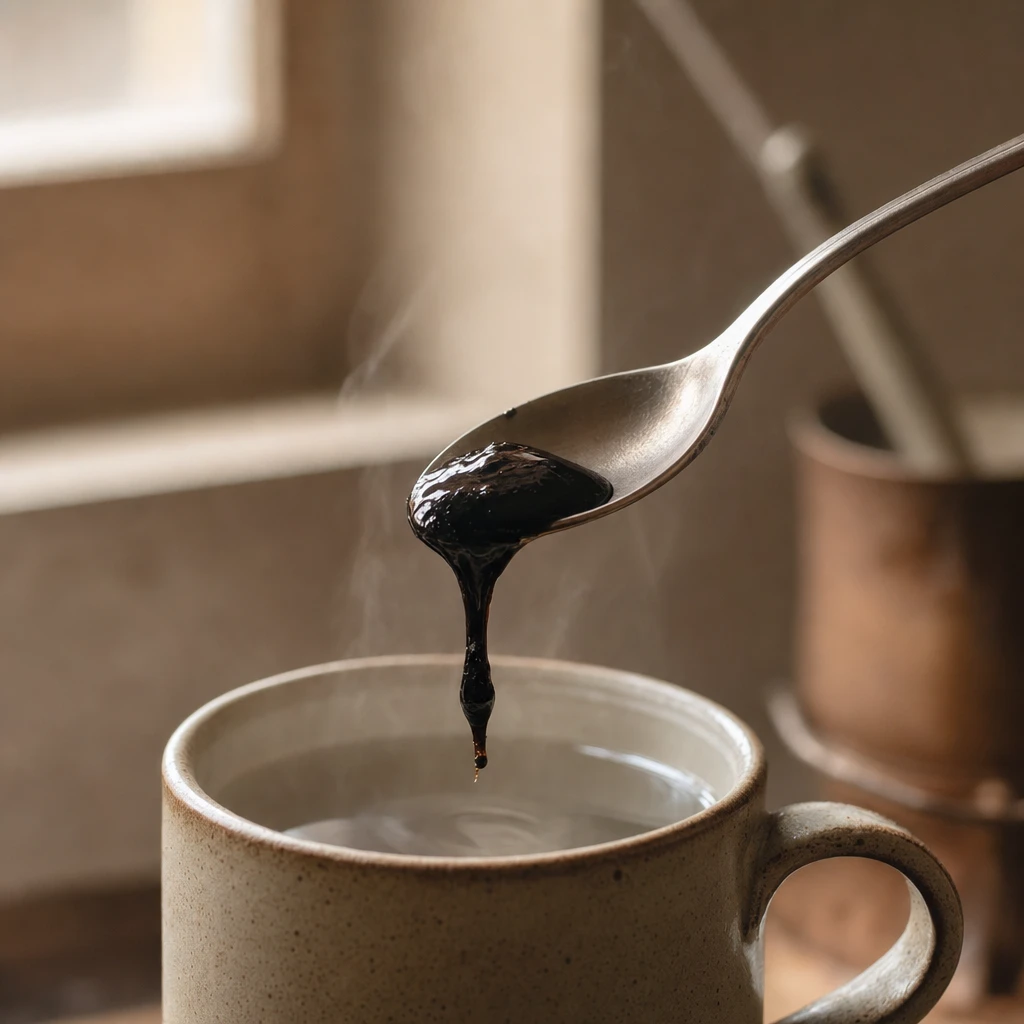
The first time you open a jar, the resin will pull a string off the spoon like warm toffee and stick to whatever it touches next. That’s normal. And it’s the part nobody warns you about. Dosage turns out to be the easy bit. The questions we actually get are mechanical: what counts as a pea, why the water shouldn’t be boiling, and how to stop the stuff welding itself to a teaspoon. Here’s what we tell customers who phone us from their kitchens.
One pea-sized piece, once a day. In grams that’s roughly 0.4, which looks insulting next to a R999 jar until you do the arithmetic. Weigh it once on a kitchen scale if you own one, just to calibrate your eye, then stop weighing it. Nobody keeps that up.
At 0.4g a day the 40g jar runs about 100 days, so R999 works out to about R10 a day and R25 a gram. The 15g jar is R500 for about 37 days, which is about R13 a day and R33 a gram. But the small jar is worse value per gram, and it’s still the one we’d start a first-timer on. You’ll know inside a week whether you can live with the taste.
More isn’t better here. A pea is roughly 400 mg and the trials that report a dose sat at 500 mg a day, so a second pea puts you past anything anyone has actually tested. Pandit 2016 in Andrologia gave 75 healthy men aged 45 to 55 that same 500 mg of purified shilajit for 90 days and reported total testosterone about 20 per cent above placebo (PMID 26395129). Read that population line twice. If you’re 28, that trial wasn’t about you. Most of the positive trials used a standardised extract called PrimaVie instead of raw resin, the samples are small, and plenty of that research is paid for by people who sell shilajit.
Drop your pea into 150 to 200 ml of warm water and stir. Warm means what you’d happily sip straight away, roughly 40 to 60 °C, not water fresh off the kettle. Boiling gets you nothing. The resin dissolves perfectly well at tea-drinking temperature, and fulvic acid is an organic acid, so parking it at 100 °C is a gamble with the compound you’re paying for (35g/100g by titration in batch 250915). You’d also have to stand there five minutes waiting for the cup to cool.
Cold water is the other failure mode. Resin sits in a sulky lump and you’ll stir for ages. So if yours won’t dissolve, warm the water before you blame the jar.
Shilajit is the only supplement we know of that can take a kitchen hostage. Two habits sort it out.
Warm the spoon first. Dip a stainless steel teaspoon into your cup of warm water for three or four seconds, scoop, then stir it straight in. Warm metal lets the resin go. A cold one hangs onto it. If it’s being stubborn, stand the whole spoon in the water for half a minute and it releases on its own.
Then there’s the fridge trick. That’s the one that changes your morning. Keep the jar in the fridge and the resin firms up, so you break off a clean piece instead of drawing a long sticky thread across the counter. This matters more in Durban than in Bloemfontein. Ours goes noticeably softer on a kitchen counter in January, and that’s heat and humidity, not a fault in the jar.
The last rule is dull and worth following. Dry spoon, dry hands, lid back on. Water in the jar is how you turn a hundred days of resin into a science experiment.
Bitter and smoky, a bit like licking the inside of a cold braai. It isn’t pleasant in week one and then it stops mattering. If your resin tastes sweet, or tastes of nothing much at all, be suspicious, because the fakes tend to be cut with something friendlier.
Honey isn’t cheating. A teaspoon of honey, or rooibos or warm milk instead of plain water, changes nothing about the resin and makes the habit survivable, which is what decides whether the jar gets finished. Some people put the pea straight under the tongue instead. That’s allowed, it’s grim, and most of them are back on the warm-water method by Thursday.
Morning, on an empty stomach, is both the traditional instruction and the convenient one. Nobody has tested that properly, though. None of the trials we cite compared a morning dose against an evening one, so anyone telling you 6am beats 9am is guessing. Pick the moment you’re least likely to skip. For most of our customers that’s next to the kettle before work.
One exception. A few customers tell us it feels a bit stimulating, so if that sounds like you, keep it before mid-afternoon.
While you’re making that first drink, check what you bought. It’s the one quality test an ordinary person can run at home, and it costs a minute.
Ours measured 97.2g/100g soluble in water by gravimetric method, batch 250915, tested at Qarshi Research International (ISO/IEC 17025 accredited, ILAC member) between 28 November and 8 December 2025. So about 3 per cent of what you stir in won’t go into solution, and any brand promising a clean 100 per cent is rounding hard or making it up. The full certificate, including lead, arsenic, mercury and cadmium all not detected by AOAC 999.10/11, sits on our lab results page.
The teacup has a hard limit, though. It shows whether you’re holding resin or a lump of something pretending to be resin. It tells you nothing about heavy metals, which is why every batch goes to a lab before it goes into jars. A 2025 paper in BMC Chemistry ran six commercial shilajit products through the lab and picked up thallium in five (Kamgar, PMID 39827344). Not one of those would have looked wrong in a cup of water.
There’s no good reason to. The trials that report a dose used 500 mg once daily, and doubling up mainly doubles what you spend. One pea a day is what we recommend, and it’s what the 100-day figure assumes.
Yes, as long as the drink is warm instead of boiling. Rooibos and warm milk both work well, and honey makes the first week easier. Skip iced drinks, because resin won’t dissolve properly in cold liquid.
Give it a full jar. The shortest trial we cite, the Yadav 2026 open-label pilot, ran 28 days on 25 healthy young men taking resin, and recorded strength and fatigue improvements while testosterone stayed unchanged. Small study, no placebo group, so treat it as a hint and not a promise. A hundred mornings gives you a fairer read than a fortnight does.
No, but it helps. Room temperature is fine for storage. A cold jar just breaks cleaner, which you’ll appreciate through a coastal summer. Keep the lid on and keep water out.
Nine times in ten the water’s too cold or you stopped stirring too early. Warm the water, give it a full minute, and stand the spoon in the cup. If it still leaves grit after all that, you’re probably looking at filler.
Tomorrow morning, weigh one pea so you know what 0.4g looks like on a teaspoon. Then put the jar in the fridge, warm the spoon, and stir it into a cup of water you’d be happy to drink. Do that for a jar’s worth of mornings before you decide anything. If you’re still choosing between sizes, the 15g jar is the smaller commitment at R500, and the batch 250915 certificate is worth reading before you spend a rand.
A complementary product, not a medicine. Pregnant or breastfeeding women, and anyone on chronic medication, should speak to a health professional first.
We publish the full laboratory report for the batch shipping now, with the method named beside every result. Read it in full.
See the certificate