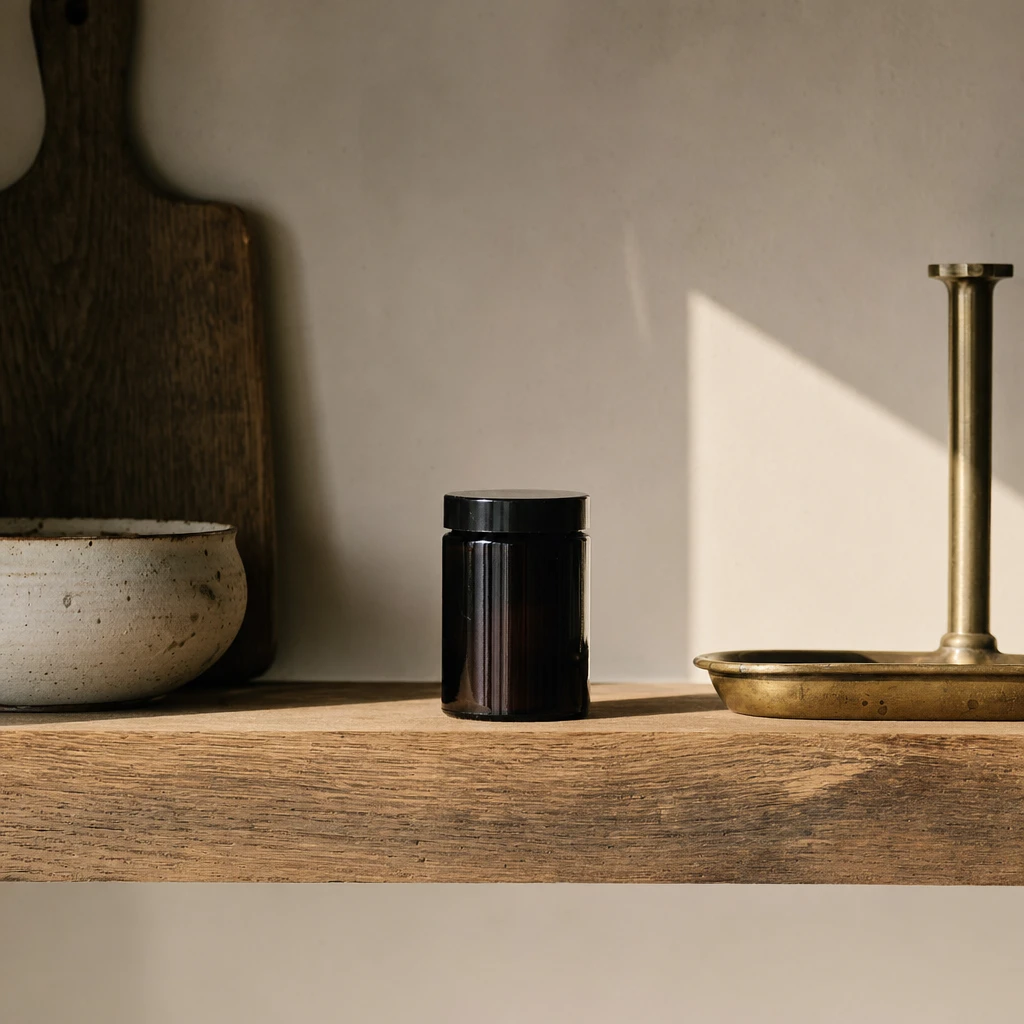
Leave a jar of resin on a windowsill in Umhlanga through February and it doesn’t melt. It slumps. Open the lid a week later and the whole lot has slid to one side, glossier than the day it arrived, and your pea-sized dose is a smear across the spoon. Nothing has gone wrong. That’s a resin behaving like a resin at 32 degrees.
We get these messages every summer, mostly from the coast, usually with a photo attached and the word “melted” in the subject line. So here’s how to store shilajit in a South African house, and the one thing that genuinely spoils a jar. It isn’t the weather.
Shilajit resin is a thick humic substance with very little free water in it, and like most resins, temperature decides how stiff it is. Cold, it behaves like toffee out of the fridge and you lean on the spoon. Warm, it flows, slowly, the way honey does. Around 25 degrees it starts moving on its own. By 30 it’s pooling at the bottom of the jar.
Humidity adds a second thing. Resin is hygroscopic, so it pulls moisture from the air, and a jar opened twice a day in Durban in January goes tackier than the same jar in a Bloemfontein winter. Same product. Different air.
The part that irritates people who wanted a tidier answer: this is one of the few honest texture tests you can run at home. A resin that holds exactly the same consistency through a Durban summer, never softening, never sagging, is behaving strangely. Either it’s been thickened with something that sets, or there’s less resin in there than the label suggests. And we’d rather have the jar that slumps. The rest of the home checks are in how to spot fake shilajit.
Easiest fix in the article. Put the closed jar in the fridge for ten minutes before you scoop and the resin stiffens enough to lift a clean pea-sized piece instead of dragging a thread across the counter. Twenty minutes if the kitchen’s been at 35 degrees all afternoon.
Two things to get right. Use a dry spoon, and don’t make the fridge its permanent home. A cold jar carried into humid air collects condensation the moment you open it, and water in the jar is the real problem. Cool it, scoop it, close it, back to the cupboard.
Nearly every ruined jar we’ve heard about got there the same way. Someone stirs their coffee, goes back with the same wet teaspoon, and leaves a film of diluted resin sitting on the surface. Undiluted resin holds too little free water for much to grow in. That watery film on top doesn’t.
So dissolve it in the cup, never in the jar. Scoop the pea out, drop it into warm water rather than boiling, around 60 degrees, and stir for thirty seconds. Our current batch, 250915, measured 97.2g/100g solubility in water by gravimetric analysis at Qarshi Research International, an ISO/IEC 17025 accredited lab. That’s why it goes in without leaving grit at the bottom of the mug.
A cupboard. That’s most of the answer, but the details matter in a hot country.
Resin keeps well, and the low water content is why, the same reason honey lasts. Stored dry and closed it holds up for years. The 40g jar is only about a hundred days of use at a pea a day, so most people never get near the question.
What to watch for is short. Fuzzy growth on the surface, which only happens once water has got in. A sour or fermented smell where there should be a smoky, bitter one. Those two. A shift in shine, or the resin going runny in February, isn’t spoilage. If it smells wrong, don’t eat it, and tell us when you bought it so we can trace the batch.
One more thing, because storage advice assumes the contents were fine to begin with. A cupboard can’t fix what was already in the jar. An analysis of six commercial shilajit products in BMC Chemistry, 2025 found thallium in five of them. Six products is a small sample and no brands were named, so it tells you nothing about any particular jar on a South African shelf. But it’s the reason we publish a full certificate of analysis per batch instead of a badge. Batch 250915 came back with lead, arsenic, mercury and cadmium all not detected by AOAC 999.10/11, and fulvic acid at 35g/100g by titration. Our standard covers what we ask the lab for.
Yes to the fridge, no real point to the freezer. Ten minutes of cold firms a soft resin enough to lift a clean pea. Full-time fridge storage works too, but let the closed jar stand on the counter for a few minutes before you open it, otherwise condensation forms on the cold surface. Freezing takes the resin rock hard, and the thaw puts water where you don’t want it.
Almost certainly, yes. Softening and pooling is ordinary temperature behaviour for a resin, and it reverses as soon as the jar cools. Judge it on smell and on whether anything is growing on the surface, not on how stiff it is in a Durban summer.
Kept sealed and dry it lasts a long time, though we’d still work to the date printed on your jar. The 15g is about 37 days of use and the 40g about 100. Most jars are finished long before shelf life gets interesting.
No, same rules for both. The difference is time. The 40g jar at R999 stays open for about a hundred days, roughly three times as many openings as the 15g at R500, and three times the chances of a wet spoon. If your kitchen sits in coastal humidity all summer, that’s the one honest argument for the smaller jar, even though it works out dearer per gram.
Go and look at where your jar is standing. If it’s near the kettle, beside a window, or anywhere the afternoon sun reaches, move it into a closed cupboard and give it ten minutes in the fridge before the next scoop. That’s the whole routine. If you’re still deciding whose resin belongs in that cupboard, read the batch 250915 certificate before you buy anyone’s, ours included.
A complementary product, not a medicine. Pregnant or breastfeeding women, and anyone on chronic medication, should speak to a health professional first.
We publish the full laboratory report for the batch shipping now, with the method named beside every result. Read it in full.
See the certificate