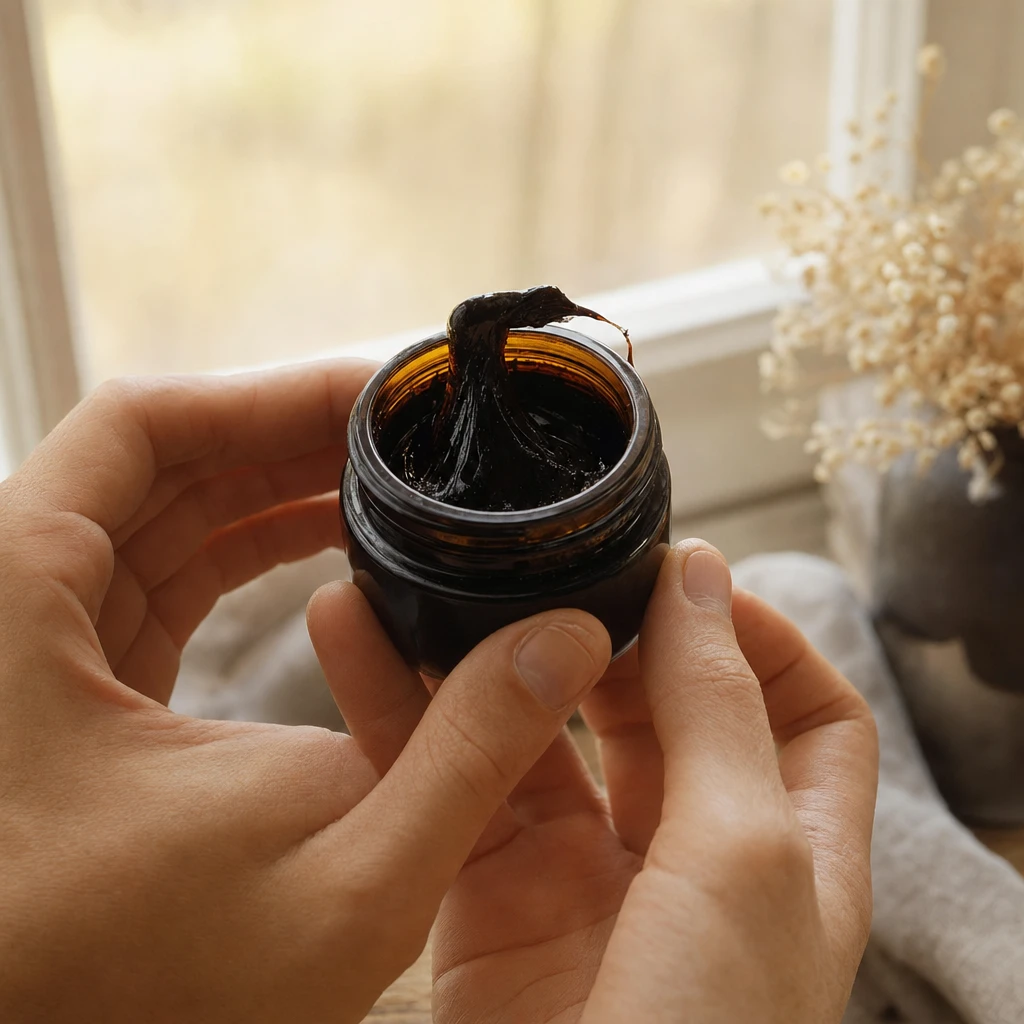
Shilajit is a dark, sticky resin that looks more or less identical whether it came off a Himalayan rock face or out of a mixing bowl. And that’s the whole problem. Photographs prove nothing, labels are unregulated, and the difference between the real thing and something else stays invisible until you test it.
Seven checks, then. The first two matter most, and both happen before you buy. The rest you can run at your kitchen table with a mug of warm water.
This one filters out most of the market in about five seconds. A seller should show you a laboratory report for the batch on sale without being chased for it, from a laboratory they name.
No certificate, no traceability. And a certificate should carry a batch number and a test date, or it could belong to any batch from any year. Any label can say “lab tested”; the ink costs nothing.
A number without its method isn’t information. Fulvic acid measured by titration and fulvic acid measured by ISO 19822 give different answers on the same material, which is exactly why some sellers quote a figure and stay quiet about how they got it.
Heavy metals, same thing. “Not detected” should have the method sitting next to it, and ideally a detection limit too, because not detected at a generous limit is a much weaker statement than it looks.
Stir a pea-sized amount into warm water. Not boiling. Purified resin dissolves almost completely and colours the water a deep reddish brown. Our batch 250915 measured 97.2 per cent soluble by gravimetric method.
Grit that settles at the bottom and refuses to go anywhere is worth asking about. So is anything that leaves an oily film. If nothing’s moving at all, check your water temperature before you draw conclusions, because cold water will stall the test on its own.
Real resin responds to temperature. It softens and turns tacky in your hand or on a warm day, and it firms up in the fridge. Something that holds exactly the same texture at 5 degrees and at 30 degrees isn’t behaving like resin.
In South African humidity, softening is normal and doesn’t mean the jar has spoiled. Ten minutes in the fridge sorts it out.
Shilajit tastes bitter and earthy, and most people find it strong on the first try. A sweet, mild or pleasant flavour is a reason to ask questions rather than a selling point, because something has probably been added to get it there. Of the kitchen tests, this is the one we’d trust least. Bitterness is easy enough to imitate.
If the taste is the problem rather than the suspicion, stir it into warm water with a spoonful of raw honey. That’s how it’s traditionally been taken anyway.
Anyone can buy five-star reviews, so start at the bottom. The one and two-star reviews carry the useful information; read them for patterns rather than individual complaints: repeated mentions of grit, of nothing dissolving, of a sweet taste, of a seller who never replies.
One or two unhappy customers is normal for any product. But a seller who has never answered a single one of them is telling you exactly what their after-sales service will look like on the day your own jar turns up late, or soft, or not at all.
Somewhere on the site there should be an address, a phone number and a person who picks up. When all three are missing, you already know how a complaint about your jar would go.
Ask a seller two questions and watch what happens: what batch is this jar from, and can I see that batch’s report? An honest answer comes back quickly. A vague one is an answer too.
For batch 250915, analysed by Qarshi Research International, accredited to ISO/IEC 17025:
| Parameter | Result | Method |
|---|---|---|
| Lead | Not detected | AOAC 999.10/11 |
| Arsenic | Not detected | AOAC 999.10/11 |
| Mercury | Not detected | AOAC 999.10/11 |
| Cadmium | Not detected | AOAC 999.10/11 |
| Fulvic acid | 35g/100g | Titration |
| Solubility in water | 97.2g/100g | Gravimetric |
The full report, including moisture, ash and pH, sits on our certificate of analysis page, and there’s more about the process in how we test.
Run the seven checks on us first if you like. We sell purified Himalayan resin in a 15g jar at R500 and a 40g jar at R999, about R10 a day on the bigger one, and every batch is analysed at a laboratory accredited to ISO/IEC 17025 with the report published in full, method beside every figure.
Don’t take our word for any of it. The certificate of analysis is published in full, so you can decide for yourself.
The heavy metal problem in this market isn’t a marketing line. A 2025 analysis of six commercial shilajit products, published in BMC Chemistry, found thallium in five of them (Kamgar 2025). Five out of six. That’s the background any jar should be judged against, including ours.
A complementary product, not a medicine. Pregnant or breastfeeding women, and anyone on chronic medication, should speak to a health professional first.
We publish the full laboratory report for the batch shipping now, with the method named beside every result. Read it in full.
See the certificate