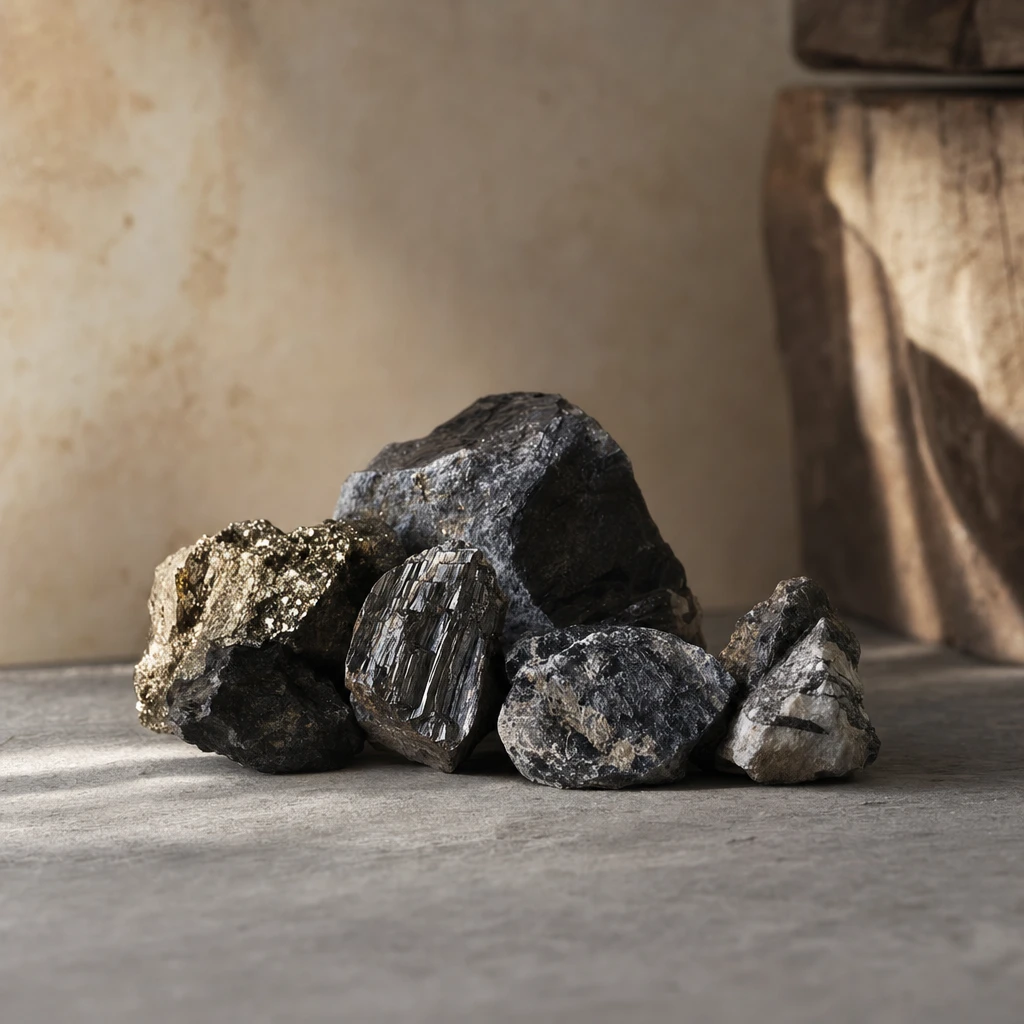
Shilajit isn’t farmed, brewed or made in a factory. It seeps out of cracks in rock faces high in the Himalayas during the warm months, which means the raw material turns up carrying whatever the rock and the soil around it were carrying first. So heavy metals are the real safety question with shilajit, more than taste, dose or the wording on the front of the jar. A jar either has a test behind it or it doesn’t.
Shilajit is plant matter that got trapped in rock seams and compressed over a very long time. In summer the heat pushes a dark, tarry exudate out of the cracks, and collectors scrape it off the cliff face along with sand, grit, bits of leaf and whatever else is stuck to it. And rock isn’t clean. Lead, arsenic, cadmium and mercury occur naturally in soil and stone everywhere on earth, at levels that shift from one valley to the next, and raw shilajit has no way of leaving them behind on its own.
Then there’s everything that happens after collection. The raw exudate gets dried, sometimes on the ground, sometimes on a roof, sometimes beside a road. It’s handled, stored, moved and sold on before it reaches anyone who purifies it. Nothing sinister in any of that. It’s ordinary handling, and it’s another place metals get in.
Purification is the step meant to sort this out. In the traditional method the raw material is dissolved in water, the insoluble sand and plant debris settle out or get filtered off, and the liquid is evaporated back down to a resin. Done carefully it removes a great deal. Done badly, or skipped entirely, it removes very little. The word “purified” on a label describes an intention. A test result describes what actually happened.
Kamgar and colleagues analysed six commercial shilajit products and published the results in BMC Chemistry in 2025 (PMID 39827344). They found thallium in five of the six.
Thallium is the part worth sitting with for a second. Hardly anybody tests shilajit for it, because the standard impurity panel used across the food and supplement industry covers four elements and thallium isn’t one of them. These researchers went looking outside the usual list and found something in nearly every sample they had. A product can pass a four-metal panel cleanly and still contain something the panel never asked about.
Now the caveats, because they matter as much as the finding. Six products is a small sample and nothing like a survey of any market, least of all ours. The paper doesn’t name the brands, doesn’t work out what a daily dose would deliver, and says nothing whatsoever about the jar in your kitchen. But it does establish that the category has a real contamination question attached to it, and that a promise printed on a label is not an answer.
Lead, arsenic, mercury and cadmium sit on almost every food and supplement impurity panel in the world. They’re there because the body doesn’t clear them the way it clears most things: they build up instead, tolerable daily intakes are set in micrograms rather than milligrams, and they occur naturally in soil, water and rock, which puts them into the food chain without anyone doing anything wrong. Regulators set limits. Labs measure against those limits. That’s the whole system, and it works only if somebody actually runs the test.
AOAC 999.10 and 999.11 are the method numbers printed next to those four results in the table further down. AOAC International is a standards body that validates analytical procedures and publishes them, so two different labs running the same method on the same sample land in the same place. In plain terms, the sample is broken down first (999.10 uses acid digestion in a microwave, 999.11 uses dry ashing), and the metals left behind are read on an atomic absorption spectrometer calibrated against known reference standards. The point of a method number is that you can look it up. “Tested for heavy metals” is a phrase you can’t check at all.
One honest note about the words “not detected”. They don’t mean zero atoms. They mean the result came back below the lowest level that method can reliably see in that kind of sample, which is a very small number, but it isn’t the same thing as nothing. Any seller who tells you their resin contains absolutely no lead is overselling somebody else’s instrument.
Ours was analysed by Qarshi Research International between 28 November and 8 December 2025. The lab holds ISO/IEC 17025 accreditation, meaning an accreditation body has assessed it as technically competent for the specific methods it runs, and it’s an ILAC member, so its results are recognised by labs and regulators outside its own country.
| Test | Result | Method |
|---|---|---|
| Lead | Not detected | AOAC 999.10/11 |
| Arsenic | Not detected | AOAC 999.10/11 |
| Mercury | Not detected | AOAC 999.10/11 |
| Cadmium | Not detected | AOAC 999.10/11 |
| Fulvic acid | 35g/100g | Titration |
| Solubility in water | 97.2g/100g | Gravimetric |
The bottom two rows measure something other than safety. Fulvic acid at 35g/100g by titration sits at the top of the 15 to 35 per cent band that genuine raw resin usually falls in. Nowhere near the 60 or 80 per cent some labels print, figures that describe a standardised extract or a method nobody names. Solubility at 97.2g/100g by gravimetric analysis answers the practical version of the same question: how much grit gets left in the glass once the resin dissolves.
The full document is on our lab tests page with the dates, the methods and the signatures on it. How we pick a lab and what we ask for each time is written up on our standard. What it can’t do is speak for a jar it didn’t test, ours or anybody else’s.
Search “shilajit heavy metals” and you get two kinds of page: brands swearing theirs is pure, and forum threads where people frighten each other. Neither is a test result. The brand pages are the worse of the two, because they’re dressed up to look like one.
We don’t know what’s in the jar in the shop down the road, and nobody writing about this knows either, because no one has tested a representative sample of what’s actually sold in South Africa. Most of it is probably fine. Stretching one paper on six products into a verdict on a whole market would be exactly the sort of overclaiming that annoys us when supplement brands do it in the flattering direction.
The honest position is narrower than either the panic or the reassurance. Shilajit’s raw material genuinely can carry heavy metals, purification quality varies enormously, and the only way to know what’s in a jar is a test on the resin that went into it, published somewhere you can read it. That applies to us as much as to anyone. If we ever stop publishing them, treat us the way you’d treat any seller who won’t show you one.
A lab report worth anything names three things:
The rest of the checks, including the ones that catch dyed coal tar and roadside resin sold as the real thing, are in our guide to spotting fake shilajit.
It’s meant to, and a careful water extraction removes a lot of what comes off the cliff face with the raw exudate. How much it removes depends entirely on how well the process is run and on what was in the raw material to begin with. Which is why we test the finished resin instead of taking the process on trust.
Usually not. Most panels cover lead, arsenic, mercury and cadmium, which is part of why the 2025 BMC Chemistry paper on six commercial products got attention. If thallium matters to you, ask before you buy. A seller who has tested for it will say so in one line.
It means the level was below what the method can detect, which is the strongest result a lab will give you. No analytical method proves absolute absence. On ours that result comes from AOAC 999.10/11, and the detection limits are printed on the document itself.
Not automatically. It’s the same raw material whichever shape it ends up in, and the metals question doesn’t care about the format. The real differences are in dose accuracy, fillers and price per gram, and on all three we think gummies come off worst. We get into that in our piece on resin versus capsules versus gummies.
Every one, before it goes on sale. The results go up on the site as they come back.
Ask the seller for the test behind the jar you already own. If nothing is published, email and ask, then notice how long the reply takes and whether a lab name comes with it. Ours is sitting on the lab tests page: lead, arsenic, mercury and cadmium all not detected by AOAC 999.10/11. If you’d rather start with the resin itself, the 40g jar is R999, lasts about 100 days at a pea-sized dose, and ships free anywhere in the country in one to three working days.
A complementary product, not a medicine. Pregnant or breastfeeding women, and anyone on chronic medication, should speak to a health professional first.
We publish the full laboratory report for the batch shipping now, with the method named beside every result. Read it in full.
See the certificate