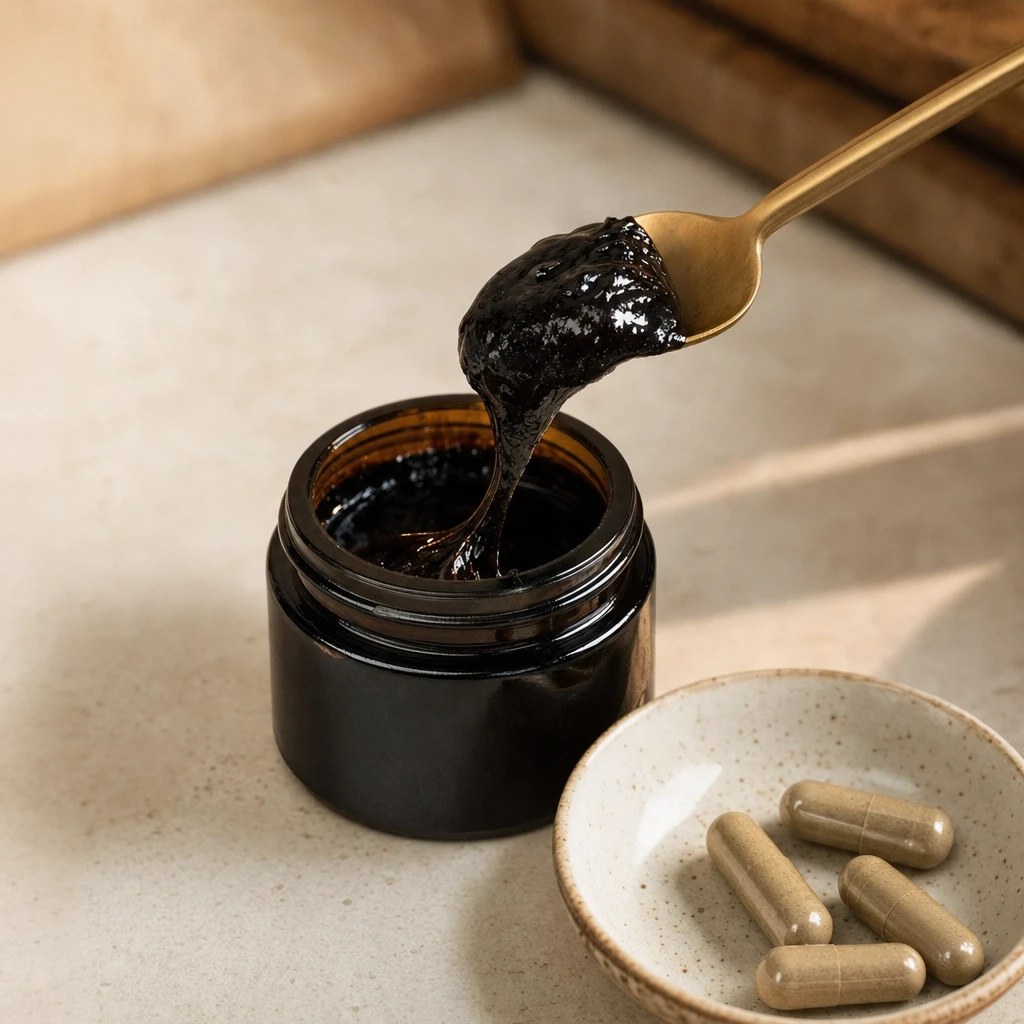
Shilajit sells in three formats in South Africa. Each holds a different amount of actual resin, at a very different price per gram of the active material. The bigger gap is how much of it you can check for yourself.
The raw material, purified and filtered, sold as a soft dark paste in a jar. A pea-sized dose is roughly 0.4g, dissolved in warm water once a day.
Resin’s case is that you can check it. It dissolves in warm water, it softens with temperature, and it tastes the way it should. None of those checks exist with a capsule. And it’s the format the laboratory analyses directly, so the certificate describes what’s in your jar rather than what went into a blend.
The trade-off is that it’s bitter and sticky, and it takes twenty seconds longer than swallowing a pill. Dosing by eye takes getting used to.
Powdered shilajit, sometimes an extract, packed into a capsule with whatever else the manufacturer chose to include. Prices start around R179, which reads well next to a jar of resin.
Capsules win on convenience, and there’s no taste. If taste is genuinely the barrier for you, this solves it.
What you give up is the ability to verify anything. You can’t watch it dissolve, you can’t judge the texture, and the amount of actual shilajit per capsule varies enormously. One US testing programme measured fulvic acid per serving at anywhere from under 7 mg to over 2 200 mg across shilajit products. So the R179 stops looking cheap once you work out the milligrams per capsule and do the per-gram sum.
A newer format, driven largely by social media. Shilajit in a sweetened, gelled base.
In their favour, they taste nice. That’s genuinely the whole list.
Against them, the sweetener and the base take up most of the mass, so the actual resin content per gummy is small, and it’s rarely stated in a way you can check. And in resin terms, a pleasant taste is a warning sign. Selling shilajit as a sweet means designing out the one thing whose bitterness tells you it’s real.
| Resin | Capsules | Gummies | |
|---|---|---|---|
| Can you check it at home | Yes | No | No |
| Content stated per dose | By weight | Varies | Rarely |
| Certificate describes your product | Directly | Sometimes | Rarely |
| Taste | Bitter, earthy | None | Sweet |
If being able to check what you’ve bought is why you’re buying shilajit at all, resin is the only format that lets you. If you’ve tried it and can’t get past the taste, capsules from a brand that publishes its testing are a fair compromise. Gummies are sweets with a claim attached. Of the three formats, they’re the one we’d tell you to skip.
We sell resin, so treat that as a stated interest rather than a neutral verdict. But the reasoning is on the page, and you can weigh it without taking our word for anything.
Batch 250915, analysed by Qarshi Research International, accredited to ISO/IEC 17025:
| Parameter | Result | Method |
|---|---|---|
| Lead | Not detected | AOAC 999.10/11 |
| Arsenic | Not detected | AOAC 999.10/11 |
| Mercury | Not detected | AOAC 999.10/11 |
| Cadmium | Not detected | AOAC 999.10/11 |
| Fulvic acid | 35g/100g | Titration |
| Solubility in water | 97.2g/100g | Gravimetric |
That 97.2 per cent solubility is the figure that matters for the at-home check. Stir a pea-sized dose into warm water and watch what happens.
Our own resin, the format this whole comparison favours, comes as a 15g jar at R500 or a 40g jar at R999, about R10 a day on the bigger one. Each batch is tested at a laboratory accredited to ISO/IEC 17025 before it ships, and the report is published in full with the method beside every figure.
If resin’s checkability is the argument, start by checking ours: the certificate of analysis is published in full.
Format doesn’t change the raw material’s risks. When BMC Chemistry analysed six commercial shilajit products in 2025, thallium turned up in five (Kamgar 2025), so ask for a batch test whether you’re buying resin, capsules or gummies, and ask us too.
A complementary product, not a medicine. Pregnant or breastfeeding women, and anyone on chronic medication, should speak to a health professional first.
We publish the full laboratory report for the batch shipping now, with the method named beside every result. Read it in full.
See the certificate