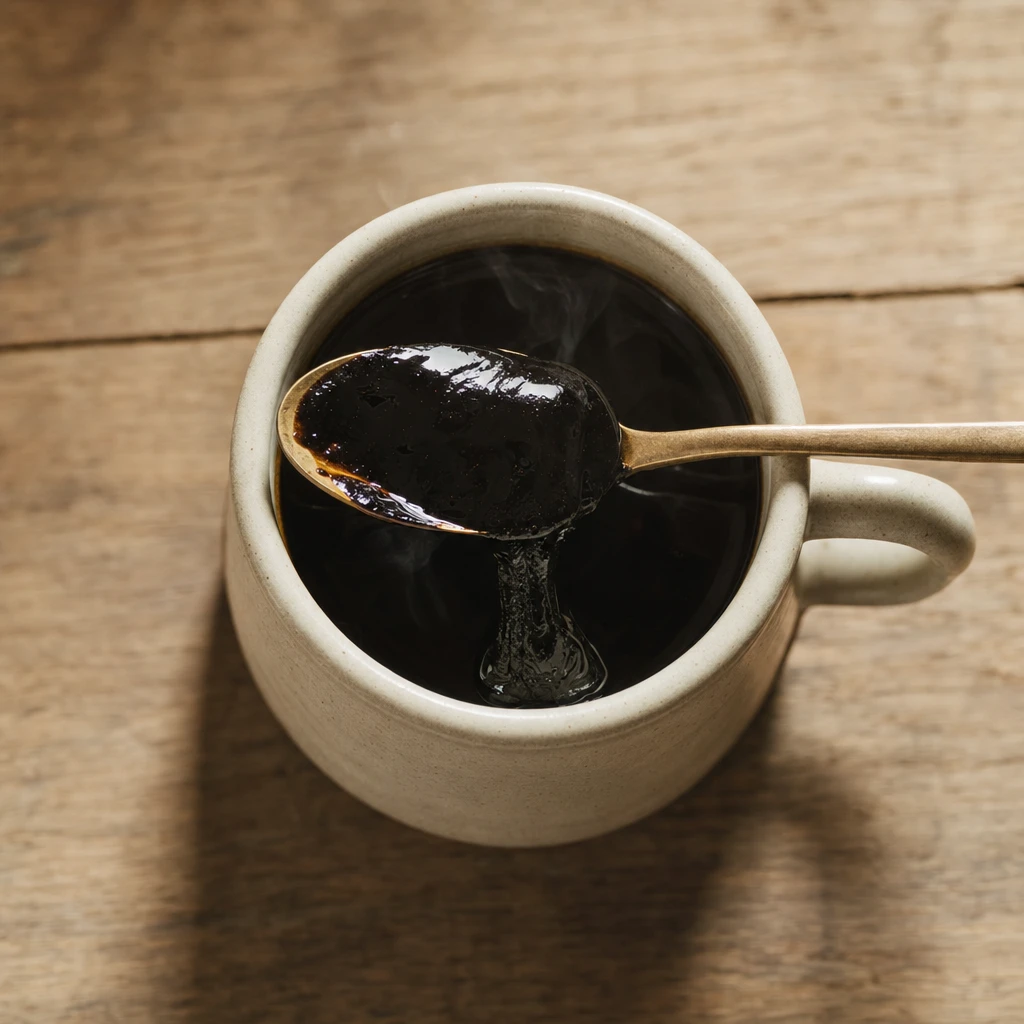
The most common message we get from a new customer, usually inside the first week, is a polite enquiry about whether the stuff is meant to taste like that. It is. Bitter first, then smoky, with a salty edge sitting underneath, closest to very strong black coffee left standing on a hot tar road. Most people pull a face. We’ve never met anyone who called it pleasant. And we’d be a little suspicious of anyone who did.
There are about four stages, all over inside a minute. The smell arrives first, peaty and mineral, like wet soil after rain. Then the bitterness, which is the loudest part and lands at the back of the tongue rather than the tip. Underneath sits a smokiness closer to lapsang souchong tea or a braai that burnt out an hour ago, plus a saltiness most people don’t expect. The aftertaste hangs about. Then it’s gone.
Dissolved in warm water it looks like weak black coffee and tastes far milder than it does neat. Straight off the spoon is the unfiltered version. Do that once for the story, then stop.
That unpleasantness does one useful job. Taste is a free quality check, and it’s one of two you can run in your own kitchen. The water test further down is the other.
The bitterness comes from the fulvic and humic acid fraction, which is the part of the resin you’re actually paying for. Our batch 250915 measured 35g/100g fulvic acid by titration, and the number and the flavour travel together. Resin that tastes sweet, caramel-ish or chocolatey has usually had something added to it, molasses and dates being the usual suspects, or it isn’t shilajit at all. But flavoured gummies are the honest end of that trade, because they don’t pretend the sugar isn’t there. Anything that markets a mild taste as a feature is telling you what it took out.
Grit is the other giveaway. Purified resin should dissolve in warm water and leave nothing at the bottom of the cup. Ours tested at 97.2g/100g solubility by gravimetric analysis, which is what “it dissolves” looks like written down. Sand at the bottom of your glass means rock, filler or a purification step somebody skipped. We’ve written up the rest of the giveaways in our guide to spotting fake shilajit.
None of this changes the flavour, so treat the list as damage control rather than a fix.
Milk and smoothies work too. Fruit juice is the one we’d skip, since the acid turns it oddly sour.
Then there’s the bit nobody believes until it happens to them. You stop noticing. The customers who mention it tell us the taste faded into the background somewhere in the second or third week, the way strong coffee or 90 per cent dark chocolate does. Two or three people now claim they actually like it. We’re not sure we believe them.
Bitterness isn’t potency. Two genuine resins from different seams and seasons taste noticeably different, and neither is stronger for it. Taste rules out the sugar-loaded fakes and stops there, because lead, arsenic, mercury and cadmium have no flavour at all. A 2025 analysis in BMC Chemistry of six commercial shilajit products found thallium in five of them (PMID 39827344), and nobody tasted it coming.
That’s what a certificate is for. Batch 250915 went to Qarshi Research International, an ISO/IEC 17025 accredited laboratory and ILAC member, and was analysed between 28 November and 8 December 2025, with lead, arsenic, mercury and cadmium all coming back not detected by AOAC 999.10/11. Those four are what our certificate covers. So read it for what it says rather than what it doesn’t. The document is on our lab tests page, and the routine behind it is set out in our standard.
Taste tells you nothing about whether shilajit will do anything for you, either. The research is small and patchy. A 2026 open-label pilot in Cureus gave resin to 25 healthy young men for 28 days and reported improvements in strength and fatigue, with testosterone unchanged. Most of the more flattering trials used a standardised extract called PrimaVie rather than raw resin, the sample sizes are tiny, several were funded by manufacturers, and the evidence base as a whole is thin. Anyone selling you a flavour as proof of anything is selling.
Yes, strongly so. Bitter and smoky is the right answer for purified resin, and that bitterness comes from the fulvic and humic acid fraction. A jar that tastes sweet, or of very little, is the one to question.
Something was almost certainly added to it. Jaggery, syrups and date paste turn up in cheap resin because sugar is cheaper than resin and easier to sell. Ask the seller for a batch certificate with the test method printed beside every number. If there isn’t one, you have your answer.
Yes, both work, and warm milk is the traditional pairing. Dissolve the resin in a splash of warm water first, then stir that in, or you’ll spend five minutes fishing out lumps.
The resin stays the same. Your palate is the thing that shifts, and going by what customers tell us, most people stop registering the taste inside the first three weeks. In a Durban February the resin goes softer and stickier in the jar, which changes how it handles rather than how it tastes.
They do, and that’s the main reason people buy them. The trade-off is that you can’t see or smell what’s inside a capsule, and part of your money goes on the shell. Resin wins that trade for us. We’ve put the three formats side by side in resin versus capsules versus gummies.
Tonight, if the jar’s already on your counter. Scoop a pea, roughly 0.4g, stir it into 100 ml of water at about 40 degrees, drink it in two goes, then have your coffee. Give it ten days before you judge, because day one is the worst it will ever be. If the flavour is what’s kept you from buying at all, the 15g jar at R500 runs about 37 days. But at R33 a gram it’s the expensive way to buy resin, since the 40g jar at R999 works out to R25 a gram over roughly 100 days.
If the taste is genuinely the blocker, the three formats sit side by side in resin, capsules or gummies. The practical side is in how to take shilajit resin, and both jars are in the shop.
A complementary product, not a medicine. Pregnant or breastfeeding women, and anyone on chronic medication, should speak to a health professional first.
We publish the full laboratory report for the batch shipping now, with the method named beside every result. Read it in full.
See the certificate