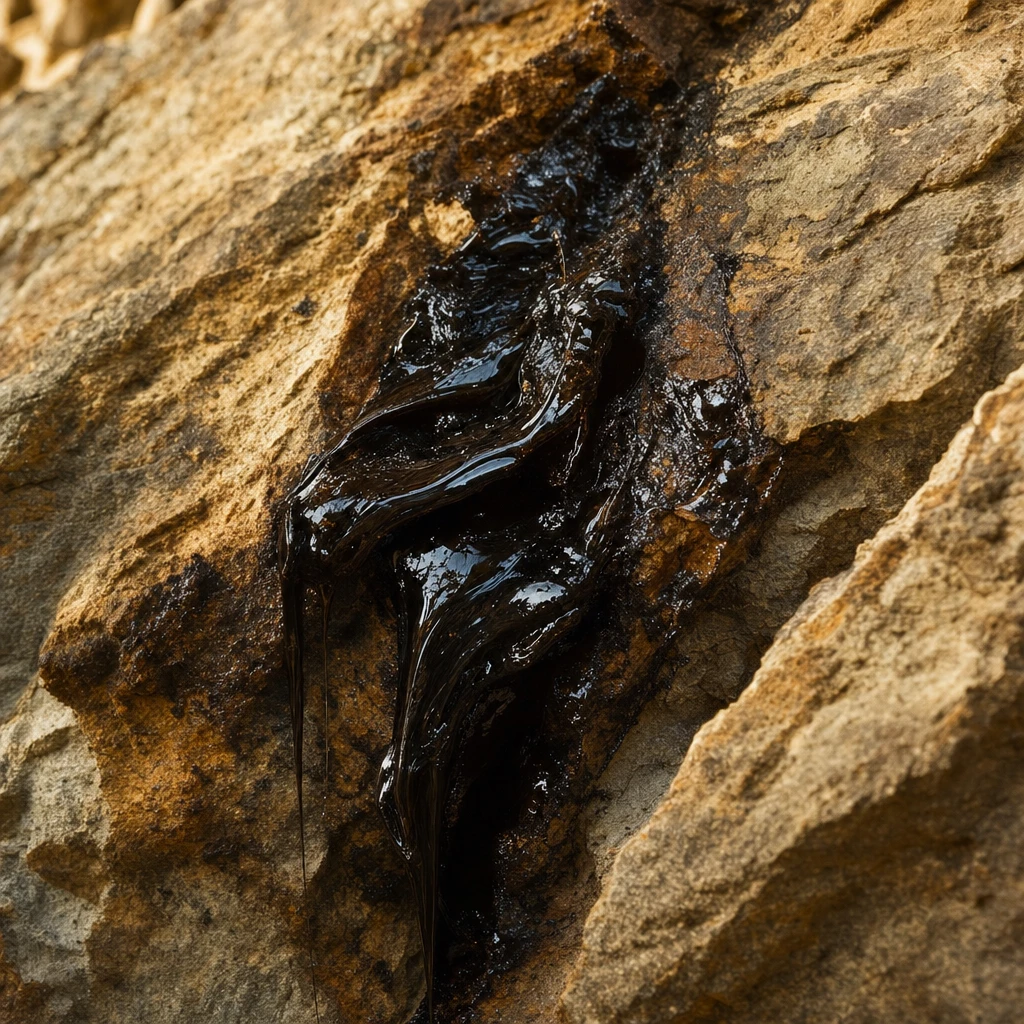
Shilajit is a sticky black resin that seeps out of cracks in high mountain rock when the weather warms up. That’s the honest version. Most of what gets written about it, the mineral counts and the mountain mysticism, sits on top of a fairly ordinary geological fact. So here’s what shilajit actually is, how it gets from a cliff face into a 40g jar, and why the word “purified” on a label proves nothing on its own.
Plant matter gets trapped in rock seams at altitude, mostly in the Himalayas, the Karakoram, the Altai and the Caucasus. Up there the cold and the thin air mean it doesn’t rot the way garden compost does. It compresses instead, worked on slowly by microbes, until after centuries what’s left is a dense organic mass packed into the seam. Then summer comes. The rock face heats up, that mass softens, and it pushes out through the cracks like sap.
Nobody agrees on exactly which plants and which microbes did the work, and the answer shifts by mountain range: mosses, liverworts and resin-bearing shrubs are all in the frame. Nobody farms it. And nobody can hurry it along, which is most of the reason real resin costs what it does.
Collectors work the seams by hand in a short summer window, often well above 3 000 m, scraping the softened material off the rock. What comes off is nothing you’d want to eat. Raw scrapings carry:
Purification separates the soluble organic part from all of that. The traditional method still underpins how careful producers work: break the raw material up, dissolve it in warm water, let it stand so the heavy grit sinks, then filter the liquid through progressively finer cloth. What’s left gets dried back down to a resin, at low temperature if the producer cares, because heat drives off the lighter fraction. Some outfits sun-dry it in open trays. Cheap, and uneven.
But purification has a hard limit. It’s a physical separation, so it takes out what won’t dissolve. It doesn’t take out lead, arsenic, mercury or cadmium that came out of the mountain dissolved along with the organic material, and it can’t undo contamination picked up from a dirty drying tray or a lead-soldered pot. A jar can be genuinely purified and still fail a heavy metals test.
No standard defines the word, and no audit sits behind it. There’s no minimum a South African buyer can check from the shelf. Any brand can print “purified” on a jar of anything black and sticky. Plenty do. What turns the word into information is a lab report with a batch number, a named lab and the test method printed beside each result.
Contamination isn’t theoretical either. A 2025 analysis in BMC Chemistry examined six commercial shilajit products and found thallium in five of the six (Kamgar 2025). Six products is a small sample, but it shows what the testing gap costs.
Ours went to Qarshi Research International, accredited to ISO/IEC 17025 and an ILAC member, between 28 November and 8 December 2025. Batch 250915 came back like this:
| Test | Result | Method |
|---|---|---|
| Lead | Not detected | AOAC 999.10/11 |
| Arsenic | Not detected | AOAC 999.10/11 |
| Mercury | Not detected | AOAC 999.10/11 |
| Cadmium | Not detected | AOAC 999.10/11 |
| Fulvic acid | 35g/100g | Titration |
| Solubility in water | 97.2g/100g | Gravimetric |
The certificate has no mineral count, because the lab didn’t measure one; the tallies printed on jars across this category trace back to marketing copy rather than an assay. Raw resin generally tests between 15 and 35 per cent fulvic acid depending on the assay, and ours came in at 35g/100g by titration, so a rival label promising 60 or 80 per cent is either describing a standardised extract or using a method it hasn’t named. The checks you can run at home are in our guide on how to spot fake shilajit.
Black. Properly black, with a tar-like sheen when the light catches it, going dark amber-brown where it thins out. Temperature changes it more than anything else does. Warm resin pulls into long strings like toffee. Straight from the fridge it’s hard enough to resist a spoon.
The smell is earthy and a bit smoky, closer to wet stone and old bitumen than to anything you’d call herbal. The taste is bitter with a salt edge behind it. The first time I tried it I was expecting something like strong coffee, and it isn’t that at all. It’s tar. You stop noticing after about a week.
Dissolved in warm water it should turn a deep amber-brown, cloudy at first, with no sand sitting at the bottom of the glass. One local note. In Durban in January, a jar left on the kitchen counter goes soft and runny. Nothing’s wrong with it. Move it to the fridge.
Resin is the raw form, purified and nothing added. Powder is resin dried and milled, which makes it easier to dose and easier to cut with something cheaper. Capsules are that powder in a shell, with bottles running about R179 to R429 in South Africa. Gummies arrived most recently, and they’re the worst of the lot: mostly sugar, with a resin content that’s small and rarely stated in a way you can check. Drops exist too, generally a dilution.
So compare them per gram, never per jar. It’s the only honest comparison and it makes the games obvious. South African resin runs roughly R13 to R46 a gram. Our 40g jar at R999 works out to R25 a gram, which is mid-market despite one of the highest sticker prices in the country. The 15g at R500 is R33 a gram, because small jars always cost more. We took the market apart in the shilajit price guide, and put the formats side by side in resin vs capsules vs gummies.
Shilajit has a long record in Ayurvedic practice across India and Nepal, where the name shifts by region to silajit or silajatu. That’s tradition. Tradition is a reason to look at something, not proof that it works.
The modern research is thin. Most of the positive trials used PrimaVie, a standardised extract, rather than raw resin, several were funded by the manufacturer, and the samples run in the dozens. In Andrologia in 2016, 75 healthy men aged 45 to 55 took 500 mg a day for 90 days, and total testosterone rose about 20 per cent against placebo (Pandit 2016). A 2019 trial in JISSN put 63 active men on 500 mg a day for eight weeks and reported strength retained under fatigue (Keller 2019). In Phytomedicine in 2022, 60 postmenopausal women with osteopenia were followed for 48 weeks, with dose-dependent preservation of bone mineral density (Pingali 2022).
Then there’s the one the category never quotes. An open-label pilot published in Cureus in 2026 gave resin to 25 healthy young men for 28 days, saw strength and fatigue improvements, and found testosterone unchanged. Younger men, raw resin instead of the standardised extract, and a result that points the other way. Read those four together and the honest position is that shilajit is worth a try and nowhere near a sure thing. That’s where we sit, and we’re the ones selling it.
A purified resin that seeps from rock seams at altitude, formed from plant matter compressed inside the rock over centuries. It’s sold as a supplement, most often as resin you dissolve in warm liquid.
No. It’s sold here as a complementary health supplement, and it’s no substitute for anything a doctor has prescribed you.
The insoluble material: sand, grit, rock, plant fibre and insect matter. It doesn’t remove dissolved heavy metals, which is exactly why the lab result matters more than the word on the label.
Resin keeps for years in a sealed jar out of direct sunlight. Heat softens it and humidity makes it sticky, and neither of those spoils it.
Yes, for our money. Resin is closer to the raw material and you can judge it with your own eyes. Capsules win on convenience, but you’re trusting a label about what’s inside the shell.
Read one lab report before you read another label. Ours is on the lab tests page, with the lab and the method beside every result. If the brand you’re considering can’t show you the same thing, that tells you plenty. Our 40g jar is R999, about 100 days at a pea-sized dose, delivered free anywhere in South Africa in one to three working days.
A complementary product, not a medicine. Pregnant or breastfeeding women, and anyone on chronic medication, should speak to a health professional first.
We publish the full laboratory report for the batch shipping now, with the method named beside every result. Read it in full.
See the certificate