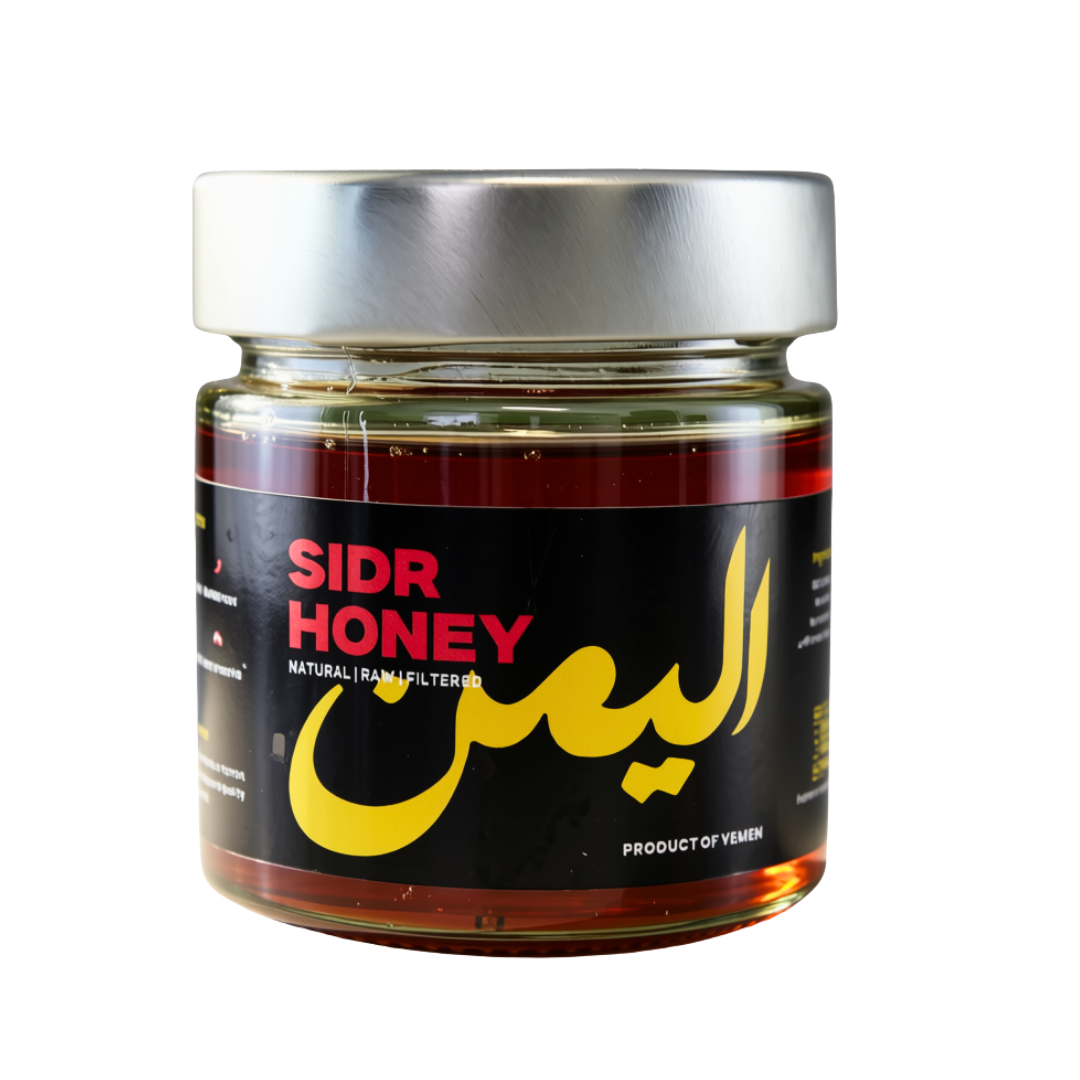
For a few weeks a year, a thorn tree called Ziziphus spina-christi flowers in the dry valleys of eastern Yemen, and beekeepers drive their hives up rough wadi roads to meet it. Sidr honey is what the bees make in that short window: the nectar of that one tree, gathered in some of the harshest beekeeping country on earth.
The honey comes out thick and deep golden, with a buttery sweetness that runs into caramel. It’s also one of the most expensive foods sold by the jar, ours included: R3 000 for 250g, in the same shop where 500g of our ordinary raw honey costs R155. The gap starts with the tree.
The sidr is Ziziphus spina-christi, a drought-hardy evergreen with a deep taproot and small waxy leaves, armed with thorns that mean business. It grows wild across the Arabian Peninsula, the Levant and the Horn of Africa, and depending on where you’re standing it goes by lote tree, jujube or beri. Yemen is where the honey’s reputation was made. The trees grow uncultivated in the valleys of Hadhramaut, and one valley in particular, Wadi Do’an, carries the sort of weight with honey buyers that Stellenbosch carries with wine drinkers. “Do’ani” on a jar marks the top of the trade.
The tree matters beyond honey too. It’s named four times in the Quran, including as Sidrat al-Muntaha, the lote tree of the furthest boundary. Plenty of sellers blur this. the tree is in the Quran. The honey isn’t.
Then there are the bees. Sidr honey is largely made by Apis mellifera jemenitica, a small bee adapted to desert heat, kept mostly in traditional hives. And because almost nothing else flowers in those wadis while the sidr blooms, the honey can come out close to monofloral, one tree’s nectar in the jar. Only a lab pollen count ever proves that, though, and no independent grading system for sidr exists.
Sidr beekeeping is migratory. When the trees start flowering, beekeepers load hives onto trucks, or onto pack animals where the roads give out, and chase the bloom into the valleys. The window is short. The main harvest happens once a year, over a few weeks, and the combs are worked by hand with simple tools, knives mostly.
The volumes are hard to picture until you see them written down. Yemen’s entire sidr crop is estimated at 300 to 500 tonnes a year, and Wadi Do’an, the origin everyone wants, at five to seven tonnes. Seven tonnes. For the whole world.
Then there’s Yemen itself: war-damaged roads and hives scattered through remote mountain terrain. And an estimated 60 to 70 per cent of exports get bought up by Saudi Arabia, the UAE and Kuwait, where sidr is a wedding gift before it’s a breakfast honey. What’s left reaches the rest of us in small, costly parcels.
Thick, first of all. Sidr is a low-moisture honey, and it comes off the spoon slowly. The colour sits between deep gold and dark amber, and jars darken and redden a little as they age. The flavour is where the money went: a buttery sweetness with caramel and butterscotch through it, malt somewhere underneath, and a finish that hangs around far longer than anything from a supermarket shelf. Ours fits that profile exactly, which is most of why we brought it in: thick off the spoon, caramel through the sweetness.
Low moisture also means it granulates slowly. Slowly, not never. If a jar eventually sets, that’s ordinary honey behaviour, and standing it in warm water brings it back.
Start at the source. Sidr that actually leaves Yemen reportedly can’t be bought at origin for under about R2 000 a kilogram, wholesale, before a single jar is filled or shipped. Retail follows from there: the commonly quoted range for Yemeni sidr abroad runs from about R2 500 to R8 000 a kilogram, with select batches claimed at up to R16 500. A specialist UK shop lists 500g of Yemeni sidr at £160, about R3 500. Our 250g jar at R3 000 works out to R12 a gram, or R12 000 a kilogram: above the middle of that international spread, below the top of it.
Now the cheaper cousins, because they explain most of the fakes. The same tree species grows in Pakistan and Kashmir, and honey from those harvests sells for a few hundred rand a kilogram. Same species. A fraction of the price. A gap that wide invites relabelling, and the scientific literature duly describes sidr as one of the most adulterated honeys in the world. One UK raw honey specialist lab-tested a batch offered to it as Yemeni sidr and got back Spanish chestnut honey. There’s no grading body policing any of this either: “Royal” and “Class A” on sidr labels are seller marketing, not certificates. So when a jar of “Yemeni sidr” turns up somewhere at a few hundred rand, the wholesale floor above has already answered the only question that matters.
These are two different products doing two different jobs. Our ordinary raw honey costs R155 for 500g, which is R0.31 a gram, and its job is daily: porridge, toast, tea, marinades. The sidr works out to R12 a gram, nearly 40 times that, and stirring it into anything hot would be a small act of vandalism. Its job is occasions.
A jar like this is usually bought as a gift that needs to carry weight, a wedding or Eid especially, and in the Gulf, where most of Yemen’s crop ends up, that’s exactly how it’s treated. It gets eaten the way it gets bought: deliberately. A teaspoon at a time, usually for guests. A 250g jar holds around 35 teaspoons, and read as 35 small occasions rather than a month of breakfasts, the price starts to make a different kind of sense.
Our advice, and we sell the thing: if you’re buying one jar of honey for the kitchen, buy the R155 one. The sidr is for the shelf the kids can’t reach.
One pairing worth knowing about, since ours is a shilajit shop first. Resin stirred into honey is a traditional way of taking it, familiar enough that we sell the two as a bundle, and a teaspoon of sidr does the job with considerably more ceremony than water. The method is in our guide on how to take shilajit resin.
One tree, a bloom lasting a few weeks, hives trucked through remote terrain in a country at war, and Gulf buyers taking an estimated 60 to 70 per cent of exports before anyone else sees a jar. Tiny supply meets wedding-gift demand, and the price does what prices do.
The tree is, four times, including as Sidrat al-Muntaha, the lote tree of the furthest boundary. The honey itself is never named, whatever the label copy implies.
Mostly taste, and what you’re paying for. Manuka runs earthy and slightly bitter; sidr is smooth and caramel-sweet. Manuka is graded and sold by the number on the jar. Sidr has no grading system at all, so you’re buying a valley and a season instead.
Price is the first filter: with a wholesale floor around R2 000 a kilogram, a cheap jar has answered you already. After that, favour a named valley and harvest over a vague “product of Yemen”. Home tests with flames or water prove nothing; only lab pollen analysis settles it.
Slowly, but it can. Low moisture drags granulation out, and a set jar is still fine. Warm water brings it back.
If you buy one, open it before the occasion you bought it for and take a teaspoon on its own. No toast, no tea. Let it sit until the caramel comes through, then decide how the rest of the jar gets used. Ours is Yemeni, raw and unheated, and the 250g jar lives on the Pure Raw Yemeni Sidr Honey page at R3 000. And if that’s more honey than your year calls for, the R155 jar will keep doing the daily work.
Honey of any kind is not suitable for babies under one year of age.
We publish the full laboratory report for the batch shipping now, with the method named beside every result. Read it in full.
See the certificate