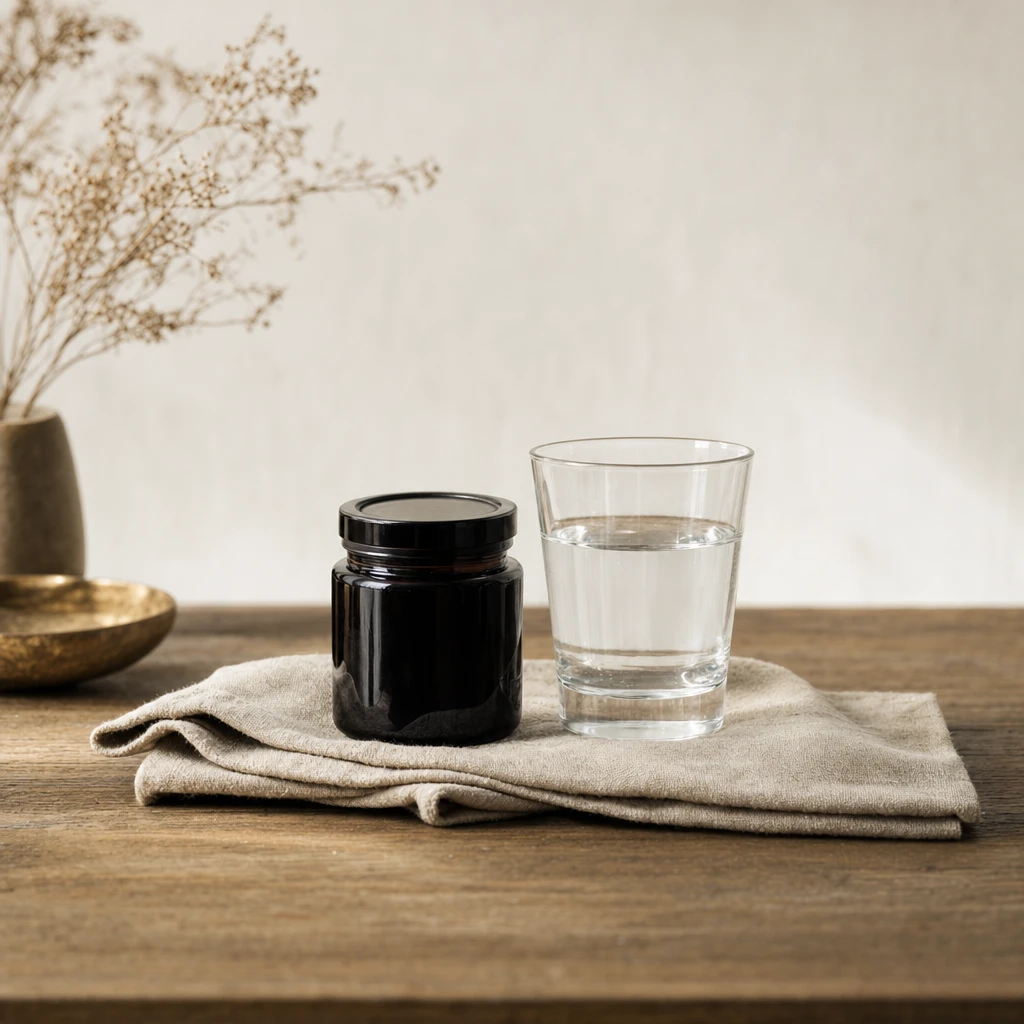
Shilajit comes out of a cliff. It seeps from rock seams in the Himalayas in the warm months, gets scraped off, and reaches us as a sticky black resin made of plant matter that spent a very long time compressed under stone. There’s no animal anywhere in that story. So the answer to “is shilajit halal” almost never turns on the substance itself. It turns on what happened to the resin after it came off the mountain, and on who signed the certificate you’re being shown.
Durban has a big Muslim community, and most of the emails we get about this come from here.
Raw shilajit is humus: decomposed plant material and minerals that have leached out of rock over a very long stretch. That distinction matters, because there’s a stubborn internet story that the stuff is animal droppings, sometimes with monkeys named as the source. It isn’t, and they aren’t. The rumour probably comes down to the look of it, since purified resin has the colour and texture of something that would fail an inspection.
But purification counts as much as origin does. Resin straight off the rock carries sand, plant fibre and whatever else was sitting in the seam, so it gets dissolved, filtered and dried down before anyone sells it.
A shilajit product picks up its halal problems in four places, and the resin itself is none of them.
Resin in a jar is the simplest case, because there’s nothing in the jar but resin. Capsules and gummies are where the questions multiply, and we’ve compared the three formats at resin vs capsules vs gummies. Gummies are the worst of them for this question, and it isn’t close: gelatine, glycerine and flavourings, most of it never named on the label. Capsules are the easier problem, since there’s only the shell to settle, though “vegetarian capsule” printed on a box is a claim like any other and the shell is what you ask about first.
A halal certificate is a statement about ingredients, process and premises. The certifier looks at the input list, where each input came from, the manufacturing method and the cleaning between runs. If it passes, the certifier issues a certificate to a named company for a named product or facility, for a fixed period, subject to audits.
People treat that certificate and a lab report as the same kind of proof. They aren’t. A halal certificate says nothing about heavy metals, fulvic acid content, or whether the black stuff in the jar is even shilajit. And a lab report says nothing about halal status.
| What you want to know | What answers it |
|---|---|
| Are the ingredients and the process acceptable under Islamic law | A halal certificate from a recognised certifier |
| Is there lead, arsenic, mercury or cadmium in the jar | A batch test from an accredited laboratory |
| How much fulvic acid is actually in it | A batch test that names the assay method |
| Will it do anything for you | Neither document, only the published research, which is thin |
That last row is the uncomfortable one. No certificate is evidence of effect, and the shilajit research is thinner than the marketing suggests: small trials, several funded by manufacturers, most of the positive ones run on a standardised extract called PrimaVie rather than raw resin. A 2026 open-label pilot in Cureus gave resin to 25 healthy young men for 28 days and recorded strength and fatigue improvements, with testosterone unchanged. Twenty-five men, no placebo group, one month. Make of that what you like.
Contamination is a live issue in this category. A 2025 analysis in BMC Chemistry tested six commercial shilajit products and found thallium in five of them (PubMed). Six products is a tiny sample, and it tells you nothing about any brand you can name, ours included. But it does make the question a fair one to put to whoever you buy from.
We’ve seen resin sold here with a halal logo and no test data, and resin with a full metals panel and no certification. Shoppers read either badge as “this brand is careful”, which is understandable and only half right. Our opinion, and you’re free to disagree: leaning on a halal logo as a purity signal is a cheat, because it borrows trust from a body that never tested for lead.
South Africa has several recognised certifiers. The ones you’ll see on packaging are SANHA (the South African National Halaal Authority), the National Independent Halaal Trust, the Muslim Judicial Council’s halaal trust in Cape Town, and the Islamic Council of South Africa. SANHA’s head office is in Durban, which is part of why this question reaches us so often. Standards differ between bodies, so a logo from one isn’t automatically accepted in a household that follows another. Certification is also a paid audit, renewed on a cycle, and smaller importers often skip it on cost. That doesn’t mean their product would fail. It means nobody has checked.
Certificates expire. They’re issued for a period, to a specific company and usually a specific product, and every South African certifier keeps a searchable list of what it currently certifies. A logo on a label is not the certificate. If halal status decides the purchase in your house, it’s the register you want, not the badge, and it takes about a minute to search.
We don’t display a halal logo, because we don’t have one to show you. Plenty of brands would let a soft line about “clean, natural ingredients” do the implying instead.
What we do publish is the batch certificate. Batch 250915 was analysed by Qarshi Research International, a laboratory accredited to ISO/IEC 17025 and an ILAC member, between 28 November and 8 December 2025. Lead, arsenic, mercury and cadmium all came back not detected by AOAC 999.10/11. Fulvic acid measured 35g/100g by titration, and solubility in water 97.2g/100g by gravimetric method. The full document is on our lab tests page, and the way we test each batch is set out at our standard.
The jar has one ingredient in it. Purified shilajit resin, no capsule shell, no gelatine, no glycerine, no flavouring, nothing else. That’s a description of the contents, not a religious ruling, and we’re not qualified to hand you one of those. If your household needs formal certification, that’s a question for your scholar or certifier and the register, rather than a supplement company. Ours included.
The resin on its own contains no animal ingredient, so the ruling usually comes down to how it was purified and what else went into the product. Solvents, capsule shells and added carriers are the three specifics worth having in hand when you take it to your scholar or certifier.
No, and we’re not going to imply otherwise. What we publish is the batch test from Qarshi Research International, and the jar holds purified resin and nothing else.
It depends entirely on the shell. Standard capsules are usually bovine or porcine gelatine, while vegetarian ones use plant cellulose, and plenty of labels don’t say which. Resin in a jar skips the question.
No. It’s decomposed plant matter and minerals compressed inside rock, and the monkey version is folklore that has followed shilajit around the internet for years. Purified resin is dissolved and filtered before it’s jarred.
Not during fasting hours, since it’s swallowed like any food or drink. Customers who take it through Ramadan generally have it at suhoor or after iftar.
Two steps. Work out which question you’re actually asking, because certification is about ingredients and process while testing is about what’s in the jar. Then it’s the document that settles it rather than the badge: the certifier’s register for halal, the brand’s own site for the lab report. If a seller can produce neither, that’s your answer.
If you’d rather see a jar in person first, about 23 independent shops around the country stock ours and they’re listed on our stockists page. If the paperwork is what decides it, the batch 250915 certificate carries the metals panel in full, and the 40g jar tested under it is R999, roughly 100 days at a pea-sized dose, delivered free anywhere in South Africa in 1 to 3 working days.
A complementary product, not a medicine. Pregnant or breastfeeding women, and anyone on chronic medication, should speak to a health professional first.
We publish the full laboratory report for the batch shipping now, with the method named beside every result. Read it in full.
See the certificate