Yes, you can buy shilajit at Dis-Chem and Clicks, but the two chains don’t sell the same thing. On 27 September 2026, Dis-Chem’s website listed two shilajit resins and one capsule product, and Clicks listed two capsule products and a gummy, with no resin at all. A spot on a pharmacy shelf tells you a chain decided to stock something. It doesn’t tell you what a laboratory found in the jar, and that’s the part worth checking before you pay.
We searched both chains’ websites for “shilajit” on 27 September 2026 and sorted what came back by format:
| Format | Dis-Chem website | Clicks website |
|---|---|---|
| Resin | 2, one of them in store only | None |
| Capsules | 1 | 2 |
| Gummies | None | 1 |
One capsule product turns up at both chains, so the two websites hold five different shilajit products between them. The in-store resin at Dis-Chem can’t be ordered online at all. Its page lists the product but not which branches have it.
So if it’s resin you’re after, Dis-Chem is the chain to phone. If capsules or a gummy will do, both have something. Chains are one route among several, and the rest are covered in where to buy shilajit in South Africa.
A website catalogue isn’t the shelf in your local branch, and both chains say as much on their own pages. Dis-Chem calls the store stock its website shows “a reference” and recommends calling your store to double-check. Clicks notes that its site isn’t showing actual stock counts, and each product page has a Find in-store button that checks the branch nearest you.
In chains this big, stock was always going to vary by branch. Dis-Chem had 316 retail pharmacy stores at the end of February 2026, and Clicks had more than 990 stores and 780 pharmacies by the end of August 2025.
Neither website listed PurePharm. We searched our own name on both, and both came back empty.
Shilajit starts life as a dark, sticky exudate that seeps out of rock layers, mostly in the Himalayas. Everything on a pharmacy shelf is some processed version of that material. And the format you pick decides how much of the label you can check.
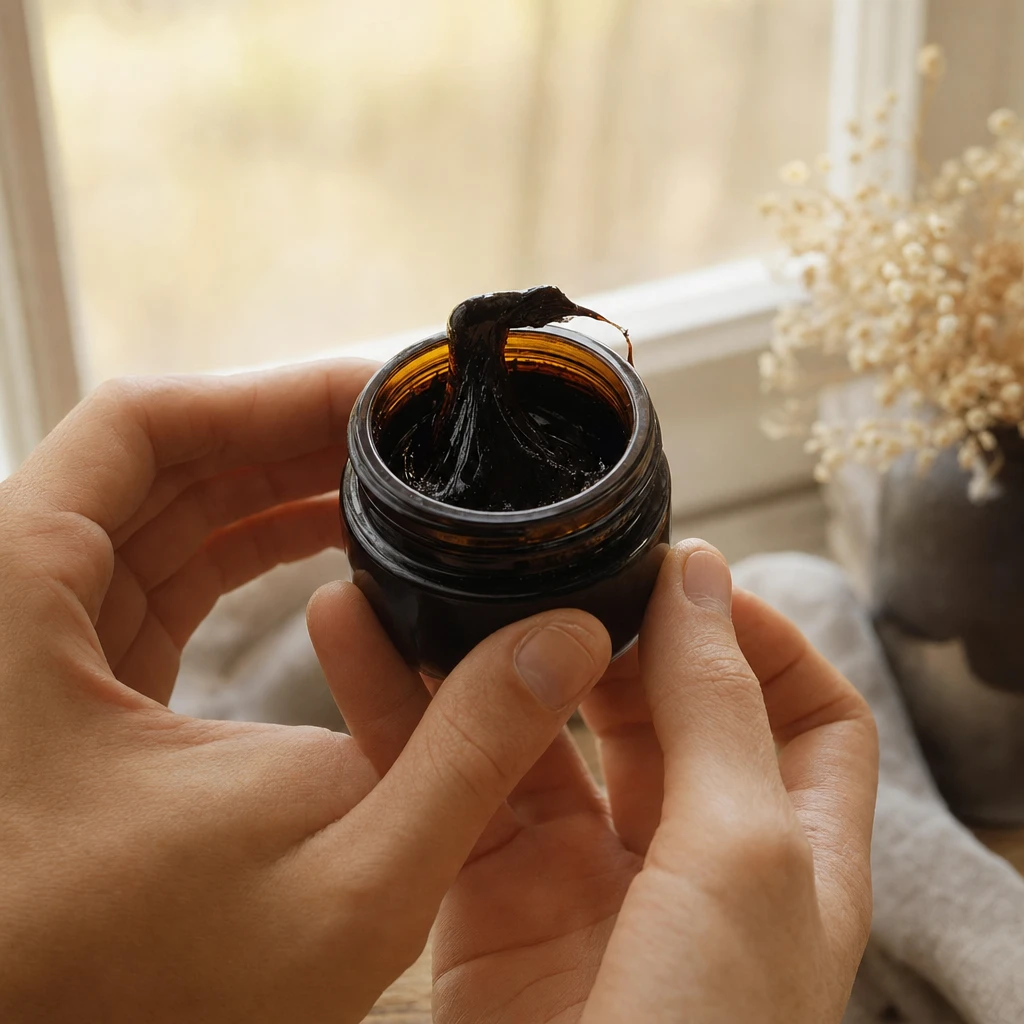
Resin is the purified material itself, sold by weight in a small jar. You take about 0.4g a day, roughly the size of a pea, dissolved in warm water or tea. The grams printed on the jar are grams of resin.
Capsules hold a powder, usually an extract. The label gives a count and a milligram figure per capsule, and sometimes an extract ratio such as 10:1, which changes what those milligrams mean. The one gummy on either chain’s website is built on glucose syrup and sugar set with pectin, with the shilajit extract further down the ingredient list, and the listing doesn’t say how many milligrams of extract are in each gummy.
Resin is what we sell, and we’d still call it the easiest format on the shelf to check, because there’s no per-unit figure or ratio to decode. Gummies are the hardest of the lot to price. There’s a longer comparison in our guide to resin, capsules and gummies.
A chain’s product page gives you the format, the pack size, the website price on the day and whether you can have it delivered or collect it in store.
What none of the six shilajit listings did was name a laboratory or link to a certificate of analysis. Four of the six gave a fulvic acid percentage, somewhere between 50% and 80%, without saying how it was measured. Three gave an extract ratio. Apart from one humic acid figure, that was everything on either website that a lab might have produced. A percentage with no test method beside it is hard to compare with anything, and fulvic acid in shilajit sets out why.
None of this is peculiar to pharmacies. It’s how complementary medicines work in South Africa at the moment. Andy Gray, who works in pharmaceutical sciences at the University of KwaZulu-Natal and sits on three technical advisory committees at SAHPRA, wrote in Spotlight on 14 August 2026 that “no complementary medicines have yet been registered”. That means no shilajit sold in South Africa has been through SAHPRA’s evaluation of quality, safety or intended use, and ours hasn’t either.
The same piece explains why shilajit turns up in so many kinds of shop. Because nothing’s been registered, these products aren’t in any schedule yet, and they’re “assumed to be controlled as Schedule 0 products, which can be sold in any retail outlet”. A pharmacy and a corner health shop are selling a jar of shilajit under the same rules.
Buy from a pharmacy by all means, but get the certificate from the brand. The pharmacist is worth talking to for a different reason. If you take chronic medication, ask them before you start shilajit, and the same goes if you’re pregnant or breastfeeding.
Turn the pack over. Everything useful is in the small print on the back.
The form and the net weight come first. On a resin jar that figure is in grams, and ours come in 15g and 40g. A capsule or gummy pack gives a count instead. The amount of shilajit in each unit is a separate line, in milligrams, if it’s printed at all.
Next, find the serving size and the number of servings in the pack. You’ll need both to work out a cost per day. A pack that gives you neither has made the sums impossible, and you’re entitled to find that annoying.
This is the line that trips people up. A milligram figure can describe the extract in the capsule, or it can describe the raw material that went into making that extract, and those are very different amounts.
An extract ratio settles which. In a 2022 paper in Frontiers in Pharmacology, Monagas and colleagues explain that a 10:1 extract means roughly 10g of dried raw material went into making 1g of extract. Labels sometimes print the “equivalent” amount of raw material instead, which is the dose multiplied by the ratio. So 50mg of a 20:1 extract can be described as 1 000mg equivalent, though the capsule still holds only 50mg of powder.
They also call it “perhaps the most common misconception” that a higher ratio means a stronger, better extract. Their paper is about plant extracts, and shilajit comes out of rock rather than a plant. But shilajit labels use the same notation, so the arithmetic carries over. If the front of a pack carries a big milligram number and the ingredients mention a ratio, ask how many milligrams of extract are in each capsule or gummy.
Resin should be resin. Ours has no fillers, carriers, flavourings or bulking agents. A capsule adds its shell and sometimes a filler, and a gummy is mostly its base. On a food-style label the ingredients run from heaviest to lightest, which is a quick way to see what most of a gummy is made of.
Shelf prices move. Dis-Chem’s own website says its sale prices online “may vary from the prices set in your local Dis-Chem Store”. So bring the sum into the shop, not a number you saw on your phone last week. Some Dis-Chem listings also show a lower special price and a separate Better Rewards discount for members, so check what the shelf tag says before you divide anything. Each format needs a slightly different sum.
| Format | What the pack states | Rand per gram | Rand per day |
|---|---|---|---|
| Resin | Price and net weight in grams | Price ÷ grams | Price ÷ (grams ÷ your daily amount) |
| Capsules | Price, count, milligrams per capsule, sometimes a ratio | Price ÷ (count × milligrams ÷ 1 000), which gives grams of capsule contents, not resin | Price ÷ (count ÷ capsules a day) |
| Gummies | Price, count, sometimes milligrams per gummy | Often impossible, because the milligrams per gummy may not be printed | Price ÷ (count ÷ gummies a day) |
For resin it’s one division. Our 15g jar is R500, which is R33.33 a gram. The 40g jar is R999, about R25 a gram. At around 0.4g a day the 15g lasts about 37 days and the 40g about 100, which puts the daily cost at about R13.50 and R10.
Capsules take one more step. Sixty capsules of 250mg each hold 15g of powder, so you divide the price by 15 to get rand per gram of capsule contents. But if those contents are an extract, a gram of them isn’t the same material as a gram of resin, and the two per-gram figures don’t line up however tempting it is to set them side by side.
Gummies usually stop you at the first step. When the milligrams per gummy aren’t printed, rand per day is the only number you can work out. That’s what the pack costs to finish, with no way to know how much shilajit was in it.
Rand per gram is the fair way to compare two resins. Rand per day is the one that decides if you’re still buying it in six months’ time.
The person at the till can tell you what’s in stock and what it costs. Only the brand has the certificate, if there is one. The quickest route is the brand’s website, which you can open on your phone in the aisle. What to ask:
A reply that says “lab tested” and stops there answers none of them, and neither does a PDF with no laboratory name or dates on it.
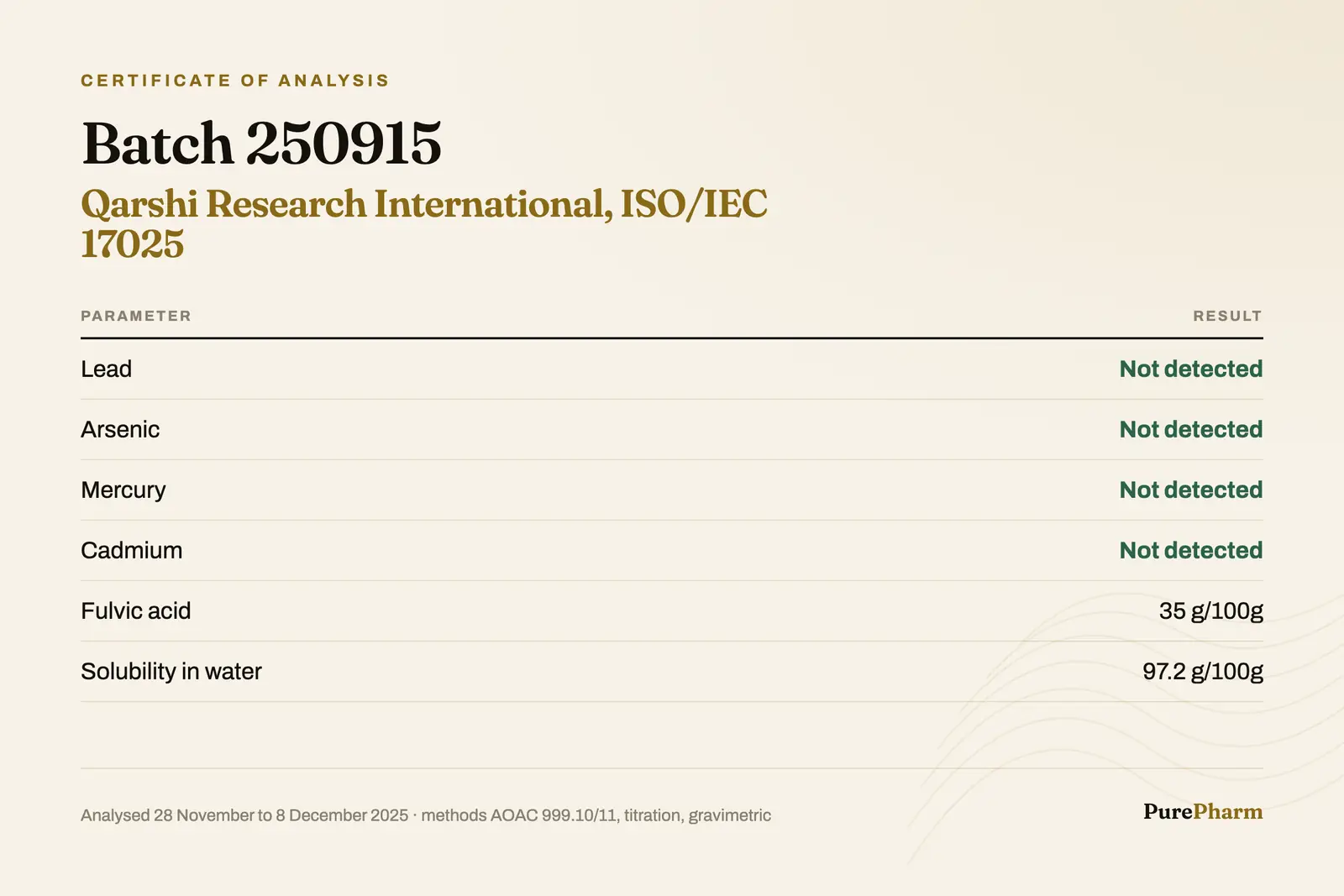
ISO/IEC 17025 is the international standard for the competence of testing laboratories. Accreditation covers a defined list of tests, though, not everything a lab does, so the standard’s name on a report only starts the checking. A useful report names the lab and the product, says which batch it covers, gives the dates of analysis and prints a method beside every result. For a “not detected” line it also shows the limit that result was measured against.
Look for lead, arsenic, mercury and cadmium in particular. There’s a line-by-line walk through one in reading a shilajit lab report, and heavy metals in shilajit covers why those four matter.
Ours is on the lab tests page. Qarshi Research International, a lab accredited to ISO/IEC 17025, tested batch 250915 from 28 November to 8 December 2025. It ran the heavy metals by AOAC 999.10/11, and lead, arsenic, mercury and cadmium were all below what that method can detect. Fulvic acid, by titration, was 35g/100g. The page has the whole report, not a cropped table, and if your jar came from an earlier batch, email us the order date and we’ll send the matching one.
Not at either chain. You can order online or try an independent shop.
Online, the 15g jar is R500 and the 40g jar is R999. Both hold the same purified Himalayan resin. Orders from R499 ship free, smaller ones cost R99 to send, and the tracking details come by email. Most land one to three working days after dispatch, and the delivery page covers outlying areas. You pay by card or Instant EFT through PayFast.
In person, independent shops listed on our stockists page have sold our resin. Small shops sell out and reorder on their own schedules, so phoning ahead is the only way to know what’s on the shelf this week.
Yes. On 27 September 2026 its website listed two shilajit resins, one of them in store only, and one capsule product. Branch stock can differ from the website, so phone your store before you go.
Not on its website when we checked on 27 September 2026. Clicks listed two shilajit capsule products and one gummy. Its Find in-store button will tell you what your nearest branch has.
Yes. Dis-Chem and Clicks both list it, and so do some independent pharmacies. No complementary medicine has been registered yet, so these products are assumed to fall under Schedule 0, which means any retail outlet can sell them.
The listings don’t say. None of the six we read on 27 September 2026 named a laboratory or linked to a certificate. Only the brand can send you the report for the batch on sale.
Work out rand per gram. Divide the shelf price by the grams of resin, or by the grams of capsule contents, and only compare like with like. Dis-Chem says its website sale prices can differ from store prices, so do the sum in the shop.
No. Neither chain lists it. The 15g jar is R500 and the 40g is R999 on our website, with free delivery from R499, and the stockists page lists independent shops that have sold it.
Bring your phone, for the calculator and for the brand’s website. Read the back of the pack, find the grams or the milligrams per unit, and check whether there’s a ratio involved. Do the division. Then ask the brand which lab tested the batch on sale, and read the answer before you pay rather than after. If nobody can name a lab, put the pack back on the shelf.
We publish the full laboratory report for the batch shipping now, with the method named beside every result. Read it in full.
See the certificate