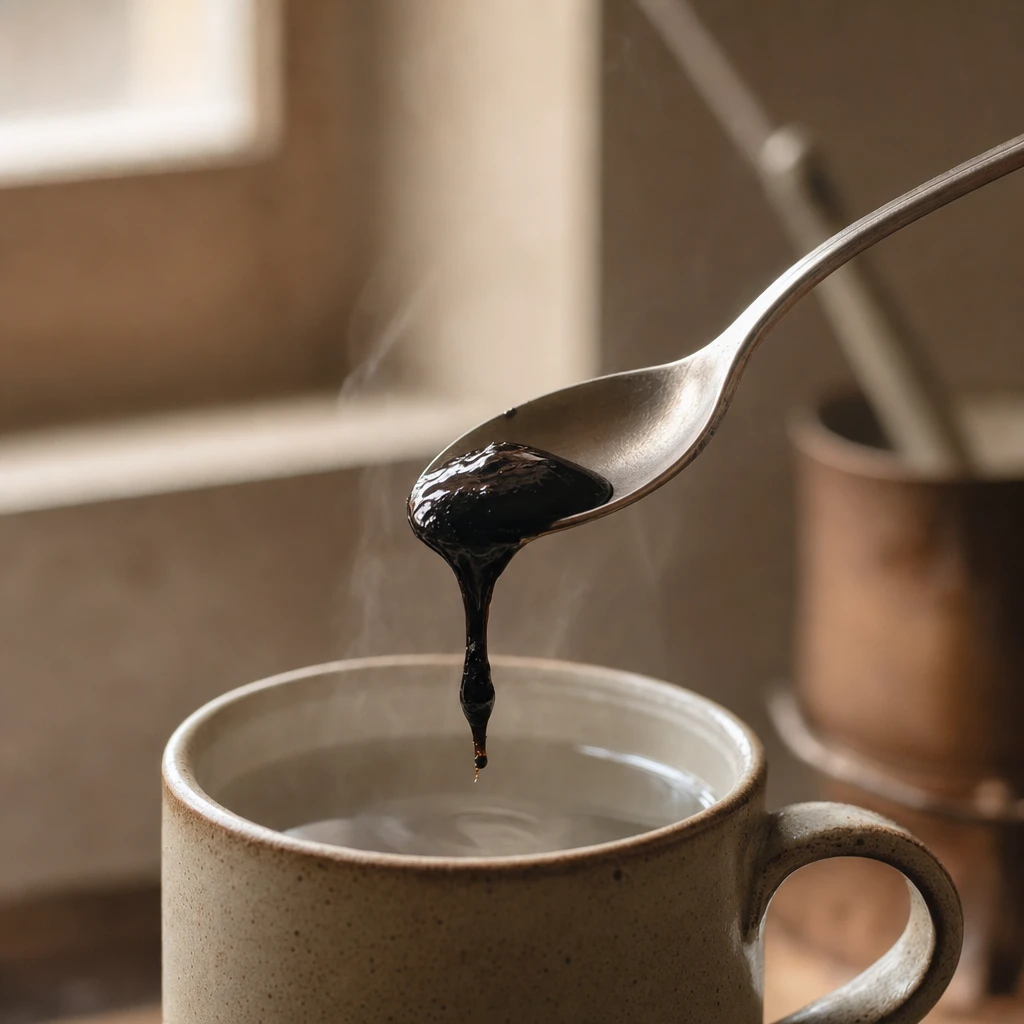
Shilajit honey means one of two things: resin that someone has already stirred through honey and sold in a jar or a stick, or a pea of resin you take with a spoon of honey yourself. We’d mix our own, every time. With premixed shilajit honey you can’t check how much resin is in each spoon, and a lab certificate for the resin says nothing about the blend unless the blend went to the lab too.
The first is the premix. Resin gets stirred through honey before you ever see it, then sold by the jar or sealed into single-serve sticks you tear open and squeeze. Some add saffron or other extras. Much of the shilajit honey sold online is one of these.
The second is a habit. You keep a jar of resin and a jar of honey, and you bring the two together each time you take a dose. Homemade shilajit honey raises its own practical questions: whether the honey is worth it, how much to use, which kind, and whether it’s cheaper to buy the two as a set.
Both get called shilajit honey, and they’re very different purchases. With a premix you’re buying something another person assembled and taking their numbers on trust. With two jars you do the assembly yourself, and you can check each half on its own before it goes anywhere near the other.
Honey gets called the traditional partner for shilajit, and in a broad sense it is. In Ayurvedic practice honey is one of the standard anupanas, the Sanskrit word for the food or drink a preparation is taken with. It also turns up in the old texts as the binder that rolls compound pills together, with shilajit as one ingredient among many.
The classical passages about shilajit on its own lean on milk, though. The Charaka Samhita (Chikitsa Sthana 1.3) has the processed resin taken with milk, and the same passage lists what it can be dissolved in: milk, buttermilk, meat soup, vegetable soup, water, urine and various decoctions. Honey isn’t on the list. The Sushruta Samhita (Chikitsa Sthana, chapter 13) has it taken each morning in a herbal decoction.
The Sushruta Samhita has some good practical detail, too. It describes the resin as “secreted from the sides of the mountains when they have become heated by the rays of the sun”, gives every kind “a bitter and pungent taste”, and prefers resin “devoid of sandy particles”. The grit check is older than the teaspoon.
So shilajit honey is a modern habit built on an old idea, and a good habit for the taste. Nobody has tested the pair in people. We searched PubMed in September 2026 for shilajit and honey together. Two papers came back, and neither one tested shilajit taken with honey. Honey changes the taste of the spoon. That’s the case for it, and for most people it’s plenty.
Start with the amount. Labels on premixed shilajit honey don’t agree on how much to tell you. Some print a resin figure per serving, and we’ve seen 400mg a stick on one product and 250mg a teaspoon on a jar. Others list shilajit among the ingredients with no amount at all. Take that 250mg jar at its word and a 0.4g serving means about 1.6 teaspoons, roughly 11g of honey, every day.
Whatever the label says, you can’t check it at home. Once resin is stirred through honey there’s no picking it back out to look at. No label tells you whether it’s spread evenly either, so the first spoon and the last may not carry the same amount.
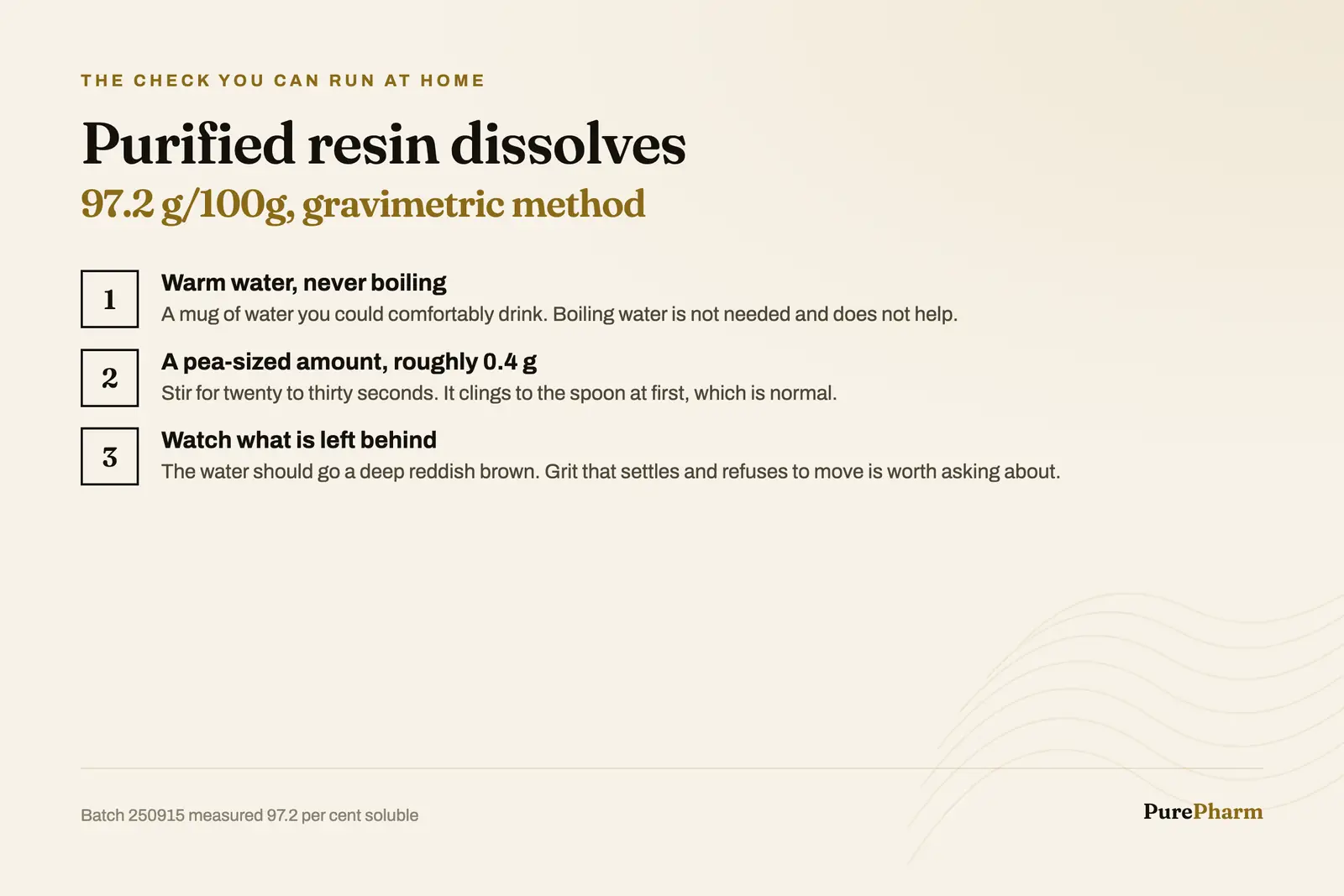
A lab report covers the sample the lab received and nothing else. Our own certificate for batch 250915 says so in its remarks: “The test report is based solely on the particular Sample (s) as received and as supplied by Customer.” ISO/IEC 17025, the standard accredited labs work to, requires reports to carry a statement to that effect. So a resin certificate can’t vouch for a premixed shilajit honey made from that resin. Only a certificate for the blend can. If a seller shows you a report, check which of the two was tested, and whether the batch number matches your jar.
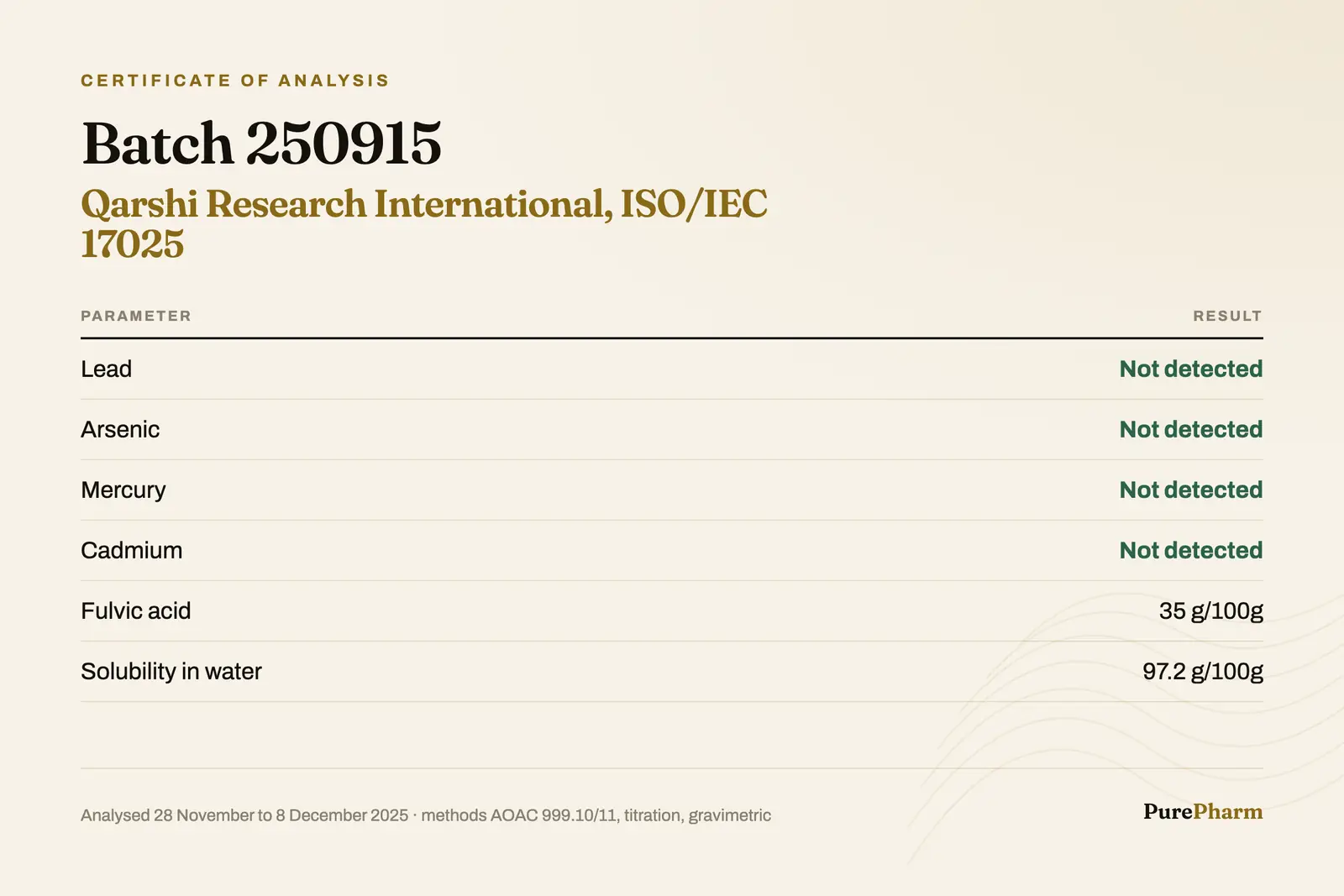
The two kitchen checks lose most of their use on premixed shilajit honey. Our guide to what shilajit tastes like counts a sweet jar as a warning sign, since real resin is bitter. A jar of shilajit honey is sweet on purpose, so that check has nothing to catch. The warm-water check in how to spot fake shilajit relies on watching the resin dissolve and looking for grit. In a blend the honey dissolves along with it, the resin is a small share of each spoon, and raw honey can carry its own fine specks of pollen and wax.
| What you want to know | Resin and honey in separate jars | Premixed shilajit honey, jar or sticks |
|---|---|---|
| Resin per serving | You see the pea, about 0.4g, every time | Whatever the label prints, if it prints anything |
| What the certificate covers | The resin sample the lab received | The blend only if the blend itself was tested |
| Taste check | Works on the resin alone | Sweet by design, so it can’t warn you |
| Warm-water check | Works on the resin alone | Clouded by the honey |
| Which honey | Your choice, with its own label | Whatever the blender used |
| Taking it on the road | Sticky, and the resin softens in heat | Sealed and portioned |
Premixed shilajit honey does get some things right, and portability is the big one. A stick is sealed and pre-portioned, and it travels without fuss. Resin starts to soften at around 25°C, so a jar left in a hot car has problems of its own. You also skip the sticky spoon. If you’re on the road more than you’re home, that convenience counts for something. You’re paying for it with the checks.
If you buy premixed shilajit honey anyway, look for three things on the pack or the seller’s site: a resin amount per serving, the word “raw” on the honey if that matters to you, and a certificate with a batch number for the finished blend. None of the premixed shilajit honey we found on sale in South Africa in September 2026 had that last one published beside it. That may change, so ask the seller for one.
Homemade shilajit honey goes on a spoon or into a cup, and in both the pea stays where you can see it.
Scoop half a teaspoon of honey, press the pea into it and swallow the lot, with something to drink close by, because the bitterness arrives a second later. Set honey is better than runny for this. The pea stays put instead of sliding off the edge of the spoon.
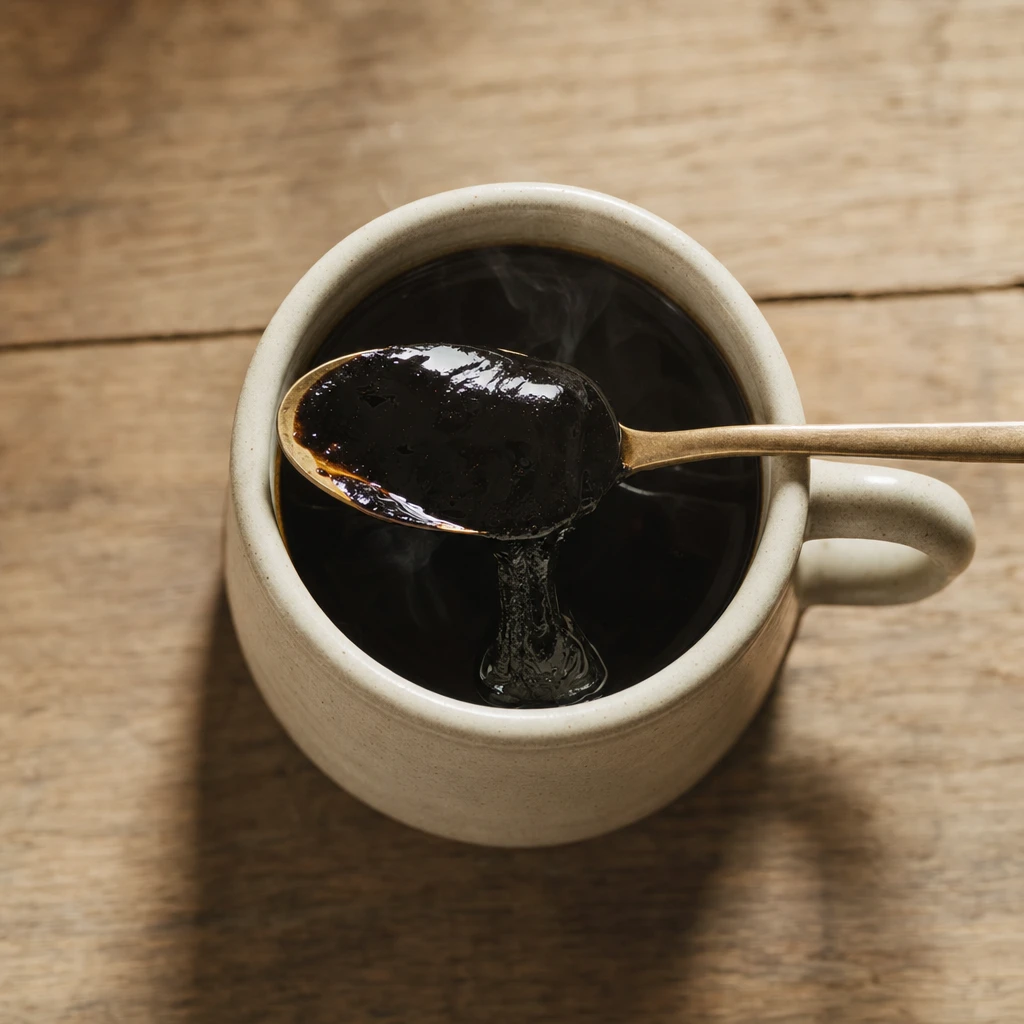
Dissolve the resin in warm water as set out in how to take shilajit resin, look at the cup, then stir the honey in. The order only matters with a new jar. That first cup is where you check the resin dissolves cleanly, and honey stirred in first would cloud the view. After that, add them in whichever order you like.
We wouldn’t make a month of homemade shilajit honey in one jar. Our resin carries water, 22.5g/100g on the batch 250915 certificate (AOAC 925.10), and honey keeps well because there’s so little water in it. There’s no published work on how the two hold up stirred together over weeks, and a dose mixed on the spoon never needs the answer. Mixing each dose fresh also keeps it at the pea you can see, about 0.4g.
Start at half a teaspoon of honey. Most of the bitterness still comes through, just blunted, and you can go up to a full teaspoon if the first week is hard going.
Use ordinary raw honey. It doesn’t even have to be raw. Any honey you’d put on toast will make decent shilajit honey.
Resin is bitter and smoky enough to flatten the flavour of whatever you stir it into, so the floral notes that make one honey different from another mostly disappear. In shilajit honey you’re paying for sweetness, and sweetness is cheap. Our 500g jar of raw South African honey is R155, or R0.31 a gram, which puts a level teaspoon at about R2.20. Its flavour shifts from season to season with whatever the bees were feeding on, which matters on toast and hardly at all under resin.
A 250g jar of our Yemeni Sidr costs R3 000. At R12 a gram, a level teaspoon comes to about R84. That’s roughly eight times what the resin itself costs per day, spent on a flavour the resin then drowns. It works in shilajit honey perfectly well. It’s just an expensive way to sweeten something bitter. If you already own a jar, keep it for eating neat, where you can taste what you paid for. What Sidr honey is explains the price. Sidr honey vs manuka covers how it compares on taste and cost.
Set honey is fine. Raw honey crystallises in time, faster in a cool kitchen, and South Africa’s honey regulations (R835 of 2000) say crystallisation “is a natural process and shall not result in the honey being down-graded”. A set spoonful holds the pea, and in a cup of warm water it melts as you stir, so there’s no need to loosen the jar first.
A level 5ml teaspoon of honey comes to about 7g, because honey is roughly 1.4 times as dense as water. Half a teaspoon is about 3.5g. Nobody levels a spoon of honey, of course, and a heaped one can hold 8 to 10g, so read every figure below as approximate.
The resin side is easy. At a pea a day, about 0.4g, the 40g jar lasts about 100 days.
| Honey a day | 500g jar lasts | 1.5kg tub lasts | Honey cost a day at R155 per 500g |
|---|---|---|---|
| Half a level teaspoon, about 3.5g | About 140 days | About 430 days | About R1.10 |
| About 5g, two-thirds of a level teaspoon | About 100 days | About 300 days | About R1.55 |
| A level teaspoon, about 7g | About 70 days | About 210 days | About R2.20 |
The middle row is the tidy one. At about 5g of honey a day, the 500g jar and the 40g jar run out together at around day 100. The 300-day set lines up the same way, with 1.5kg of honey and three 40g jars both finished at around day 300.
Take a full teaspoon and the honey goes first, at about day 70, a month before the resin. A replacement 500g jar costs R155, but on its own that’s below the R499 free-delivery line, so R99 delivery takes it to R254 at your door. The 1.5kg tub, R320 or about R213 a kilogram, is under the line too. Add either one to your next resin order and the delivery charge disappears. At half a teaspoon it runs the other way, and you’ll finish the resin with honey to spare. Honey lasts in the cupboard, so running out of resin first is the better problem to have.
The shilajit and honey set is a 40g jar of resin and a 500g jar of raw honey for R1 000. The same two jars bought as separate items come to R1 154, R999 plus R155, so the set is R154 cheaper. Compared with the 40g jar alone, the set costs R1 more. Over 100 days that’s about R10 a day, honey included. Both come to more than R499, so either way it ships free by tracked courier, usually inside 1 to 3 working days.
For a longer run, the 300-day set pairs three 40g jars with a 1.5kg tub for R2 850. Bought separately, those four containers add up to R3 317, so the set saves R467 and works out at about R9.50 a day over 300 days. At about 5g of honey a day, nothing in it runs out early.
Skip the set if you won’t eat the honey. If you already have a honey you like in the cupboard, or you’d rather take the resin in tea or warm milk than as shilajit honey, buy the 40g jar on its own for R999 and spare the honey a life at the back of the shelf. And if you’ve never tasted resin before, the 15g jar, R500 for about 37 days, is the smaller first step. There’s no 15g set at the moment, so use whatever honey you’ve got.
If you would use the honey, though, the set is the obvious buy. At R1 000 it’s the smaller of our two honey and shilajit sets.
Yes. Dissolve the pea of resin in warm water and stir the honey in after, or press the pea into half a teaspoon of honey and swallow it. The honey only changes how the dose tastes.
Half a teaspoon to a level teaspoon, about 3.5g to 7g, and we’d start at half. At half a teaspoon a 500g jar lasts about 140 days; at a full one, about 70.
Better to mix it fresh each time. There’s no published data on how resin keeps once it’s stirred through honey for weeks, and a jar mixed in advance hides the 0.4g going into each dose.
They’re handy for travel. You can’t check them, though. You’re relying on the printed resin amount, and a resin certificate doesn’t cover the stick unless the stick itself was tested. Ask the seller which one went to the lab.
Babies under 12 months shouldn’t have honey at all. For shilajit, check with a health professional before giving it to a child of any age.
No. Any honey you like will sweeten the dose, and the resin’s bitterness flattens most of a honey’s own flavour. Raw honey that has set works too.
Buy the set if the honey will get eaten, and the 40g jar alone if it won’t. Before either arrives, read the batch 250915 certificate on our lab results page. The report, issued on 8 December 2025 by Qarshi Research International, an ISO/IEC 17025 accredited laboratory, shows no detectable lead, arsenic, cadmium or mercury (method AOAC 999.10/11). On the first morning, make your shilajit honey in the cup. Dissolve the pea, check the water, then stir in half a teaspoon of honey. If the honey jar is nearly empty by day 60, you’re a full-teaspoon person, and the 1.5kg tub will suit you better next time.
Honey isn’t suitable for babies under 12 months. If you’re pregnant or breastfeeding, or you take chronic medication, check with a health professional before starting shilajit.
We publish the full laboratory report for the batch shipping now, with the method named beside every result. Read it in full.
See the certificate